


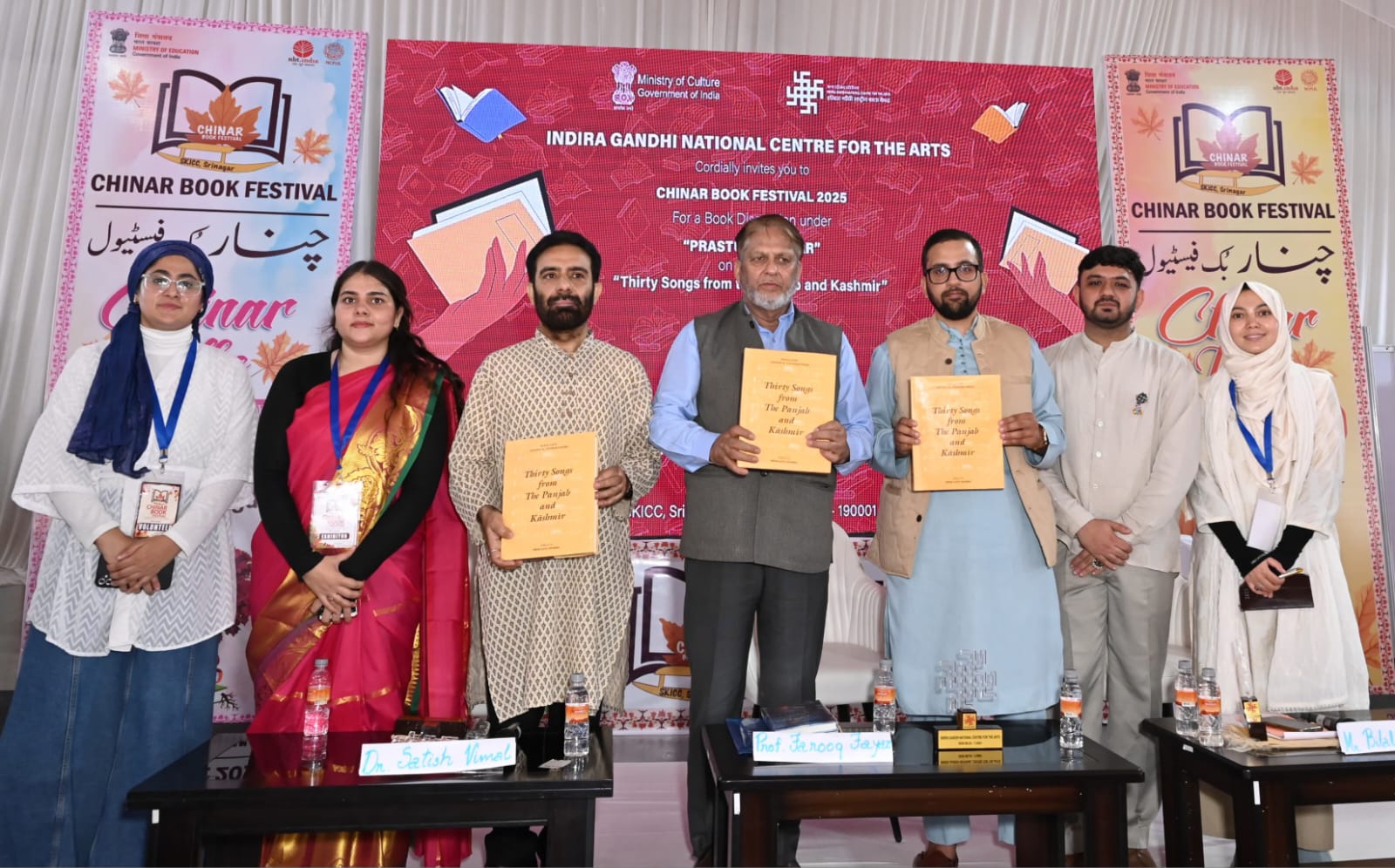
Srinagar: A captivating panel discussion was conducted by Indira Gandhi National Centre for the Arts (IGNCA) on the century-old musical-literary classic “Thirty Songs from the Punjab and Kashmir” enthralled a discerning audience at the ongoing second season of the Chinar Book Festival, currently underway in Srinagar.
Originally published in London in 1913 by Luzac and Novello & Co, the seminal volume was recorded by Mrs. Alice Coomaraswamy, popularly known as Ratan Devī, with introduction and translations by the pioneering art historian Ananda K. Coomaraswamy and a foreword by none other than Rabindranath Tagore.


The revised edition, published in 1994 by the IGNCA in collaboration with Sterling Publishers, was edited by the eminent musicologist Premlata Sharma and carries a fresh foreword by Kapila Vatsyayan.
The session featured a distinguished panel comprising renowned scholars, writers, researchers, and intellectuals Prof. Farooq Fayaz and Dr. Satish Vimal, with journalist and moderator Bilal Bashir Bhat guiding the conversation.
Opening the session, Bilal Bashir Bhat offered a succinct yet illuminating overview of the book’s genesis and bibliographic significance.
This was followed by an in-depth analysis by Dr. Satish Vimal, who articulated the literary and musical depth of the thirty folk compositions. He emphasized that the songs, originally composed in Punjabi, Kashmiri, Dogri, and Persian, resonate with universal themes of love, longing, nature, separation, and celebration, deeply rooted in the syncretic cultural fabric of Kashmir.
Dr. Satish Vimal further drew attention to the remarkable musical notations systematically embedded in the original text, underscoring their technical precision and global applicability. “It is both fascinating and unfortunate,” he remarked, “that while the book reflects an extraordinary understanding of folk musical frameworks, we have failed to preserve and transmit this legacy with the seriousness it deserves.”
Prof. Farooq Fayaz, known for his erudite scholarship in the history of Kashmir and Central Asia, spoke eloquently about the book’s historical and linguistic dimensions. “The linguistic diversity alone is staggering,” he noted. “Dogri, Punjabi, Kashmiri, and Persian coalesce to form a chorus of civilizational memory.
These songs are not merely lyrical artefacts, they are echoes of a lived past, carriers of collective emotion, and windows into the ethos of a bygone era.”
Both panelists highlighted the secular and inclusive spirit of the compilation, praising its rare attempt to encapsulate creativity across linguistic and cultural spectra. “The collection transcends religious and regional boundaries,” said Satish Vimal, “and brings together multiple layers of creativity, from peasant folk tunes to sophisticated poetic renderings, making it a unique ethnographic document.”
In his concluding remarks, Prof. Farooq Fayaz described the book as both a literary and cultural archive, one that bridges the oral tradition with modern literary sensibilities and offers an emotional map of shared artistic identities in the Punjab-Kashmir belt.
The session concluded with a vibrant audience interaction segment, during which scholars, students, and culture enthusiasts posed thought-provoking questions to the panelists. A felicitation ceremony organized by members of IGNCA followed, marking the event with warmth and academic appreciation.
Copies of Thirty Songs from the Punjab and Kashmir are available for purchase at the IGNCA stall at the festival venue.