

RELIGIOUS HARMONY IN THE FORMATION
Farooq Bhat


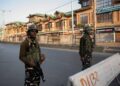
In the heart of Jammu and Kashmir, where the Himalayas cradle a land of breathtaking beauty and complex socio-political dynamics, the Indian Army’s 15 Corps, known as the Chinar Corps, is a guardian of national security and communal harmony. Tasked with maintaining peace in the Kashmir Valley, a region marked by decades of conflict and diverse religious identities, the Chinar Corps exemplifies how the Indian Army transcends divisions. Comprising soldiers from Hindu, Muslim, Sikh, Christian and Buddhist backgrounds, this formation embodies the principle that unity is the ultimate weapon in a fractured landscape.
The 15 Corps headquartered in Srinagar, operates in one of India’s most sensitive regions. Its troops Dogras, Gorkhas, Punjabis, Ladakhis and Tamil Nadu recruits reflect the nation’s pluralism. Despite the Valley’s history of insurgency and communal tensions, the Corps’ ethos prioritizes cohesion. Soldiers share trenches, patrol volatile villages and endure sub-zero temperatures together, forging bonds that override religious differences. As one jawan remarked, “In Kashmir, your faith matters less than the man beside you.”
Every battalion under the 15 Corps maintains interfaith prayer rooms. These spaces host the Quran, Gita, Bible and Guru Granth Sahib, allowing soldiers to pray side by side. Before critical operations, Hindu and Muslim troops often exchange tokens of blessings, a tilak or a dua for mutual strength. Eid, Diwali, Gurpurab and Christmas are celebrated collectively. During Ramadan, Hindu soldiers volunteer for night duties to accommodate Muslim colleague’s daily fasting. Similarly, Sikh soldiers organize langars on Guru Nanak Jayanti, serving vegetarian meals to respect diverse dietary practices.
The 15 Corps launched Operation Megh Rahat when catastrophic floods submerged Srinagar. Muslim soldiers rescued stranded Hindu families from temples while Sikh troops navigated submerged streets to deliver aid to mosques. A local Imam later recalled, “The Army didn’t ask our religion, they saved us as Indians.”
In 2019, during a raid in Shopian, Major Rajesh Adhikari and Naik Ali Ahmed neutralized militants holed up in a mosque. Their careful coordination ensured the site’s sanctity remained intact, earning praise from community leaders. The Chinar Corps’ leadership fosters harmony through deliberate strategies, Platoons are deliberately diverse. A single unit might include a Hindu sniper, a Muslim medic, a Sikh engineer and a Buddhist radio operator.
Soldiers undergo workshops to understand local customs, such as Ramadan practices or Amarnath Yatra traditions, ensuring respect during civilian interactions. This civic initiative builds schools, hospitals and bridges in remote villages. Projects are executed with input from local religious leaders, fostering trust. A recent example is rebuilding a Sufi shrine damaged in the crossfire, with Hindu and Muslim soldiers labouring side by side.
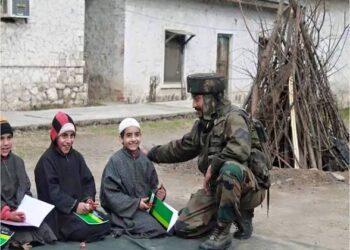
The 15 Corps navigates unique challenges: Extremist groups often attempt to portray the Army as a “Hindu force.” To counter this, the Corps organizes open houses where locals interact with Muslim and Sikh soldiers, dispelling myths. The Chinar Corps’ efforts extend beyond its ranks. Engaging respectfully with local communities whether distributing Eid sweets in Baramulla or organizing Diwali lamps in Anantnag models pluralism in a region scarred by division. Captain Priya Sharma, posted in Kupwara, notes: “When Kashmiri children see Hindu and Muslim soldiers laughing together, they learn that coexistence is possible.”
The 15 Corps’ religious harmony is not incidental but a battle-tested necessity. This formation proves that shared purpose and mutual respect can silence even the loudest divisions in a valley where discord is often weaponised. As the Corps’ motto “Never Say Die” echoes through Kashmir’s peaks, it carries a more profound message, India’s strength lies not in uniformity but in unity. The Indian Army’s religious harmony is no accident but a product of deliberate policy, leadership and shared sacrifice. It proves that diversity becomes a strength when channelled toward a common goal. As India navigates modern challenges, the Army’s secular ethos offers a blueprint for societal cohesion a reminder that unity is India’s greatest armour in uniform or civilian life. By upholding this creed, the Indian Army continues to guard not just borders but also the soul of a pluralistic India.