

AR Bhat

When the nation looks to its borders, the image that invariably comes to mind is one of relentless vigilance, soldiers standing firm against harsh terrain, freezing winds and constant threat. However, woven into the very fabric of India’s frontier regions is a quieter, equally profound narrative. Far away from the flashpoints of conflict, the Indian Army is engaged in an entirely different kind of objective. In isolated valleys, remote mountainous villages and border towns where the hum of city life fades into silence, the armed forces frequently serve as the primary catalyst for education, healthcare and community empowerment. The military recognizes a fundamental truth, securing a nation’s perimeters is only half the battle. The other half is nurturing the potential, dreams and capabilities of the youth who live within them.
At the heart of this transformative community work lies Operation Sadbhavana. Initially conceived as a localized, grassroots effort to provide immediate relief in the Jammu, Kashmir and Ladakh, the initiative has evolved into a massive, sophisticated developmental engine. Today, it stands as a testament to the Indian Army’s commitment to long-term nation-building. The resources are channelled into constructing modern healthcare centers, establishing skill-training workshops and driving women’s empowerment initiatives in areas where such opportunities are historically scarce. Crucially, it dovetails with the government’s aim to build a prosperous state, creating a unified approach to developing border infrastructure. The underlying philosophy is deeply empathetic yet highly strategic, when a community is provided with the resources to thrive, when children can attend good schools and parents have access to healthcare, it naturally fosters a profound sense of confidence. That localized confidence, in turn, builds an unbreakable psychological bridge between remote citizens and the broader Indian state.
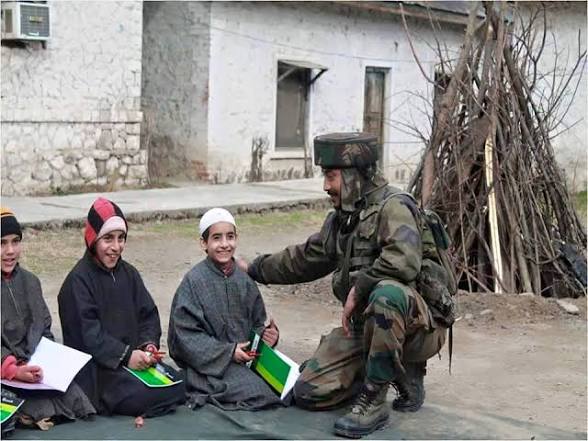
Perhaps the most striking illustration of this forward looking vision is the establishment of Army Goodwill Schools across J&K. Currently, 43 of these institutions dot the landscapes of Jammu, Kashmir and Ladakh, providing high-quality education to roughly 17,000 students. In a powerful indicator of social progress for the regions, nearly 43 percent of these students are girls. These institutions have transcended the traditional concept of a rural school. Step into one of these classrooms today and you are likely to find smart boards, digital learning tools and specialized labs dedicated to robotics and computer science. The curriculum is continuously adapted to align with the progressive standards of the National Education Policy. Furthermore, a sweeping, decade-long partnership with the Bharti Airtel Foundation has turbocharged this educational ecosystem, expanding its reach from an initial 14 schools to the entire network.
Because of these modernized resources, students are no longer just memorizing outdated textbooks. They have launched over 160 independent innovation projects and consistently secure spots in highly competitive national science initiatives, including ISRO’s YUVIKA and the INSPIRE-MANAK awards. By facilitating residential immersion programs at premier institutes like IIT Jammu and the CSIR-IIIM Srinagar labs, the Indian Army is shattering the glass ceiling for rural youth, proving that a career in cutting-edge research is within their grasp. For a teenager growing up in a secluded border district, the sheer scale and diversity of India can feel entirely abstract. Geographic isolation often breeds psychological isolation. To dismantle this barrier, the Indian Army organizes comprehensive National Integration Tours.
These carefully curated educational journeys transport students far beyond their home districts. Recently, a cohort of students and teachers from Rajouri and Poonch found themselves walking the disciplined grounds of the National Defence Academy and the Armed Forces Medical College in Pune. Similarly, engineering students from the remote upper reaches of Sikkim were flown to southern tech hubs like Bengaluru and Mysuru, where they stood inside the command centers of ISRO and the corporate campuses of Infosys. These are not mere sightseeing excursions, they are perspective-shifting experiences. Seeing a space launch facility or a multinational tech giant up close permanently alters a young person’s understanding of what is possible, seamlessly connecting the periphery of the nation to its bustling center.
The military’s investment in youth extends into its own recruitment frameworks, most notably through the Agnipath Scheme. By early 2025, nearly 1.5 lakh young men and women had stepped into uniform as Agniveers. While the primary goal is to maintain a youthful, agile fighting force, the secondary effect is a massive nationwide upskilling program. During their tenure, these recruits receive world-class military discipline, but they also undergo rigorous technical and leadership training. When their fixed service period concludes, they do not simply return to civilian life, they return as highly capable, certified professionals. Backed by a substantial financial safety net known as the Seva Nidhi and benefiting from reserved employment opportunities in the Central Armed Police Forces and Indian Railways, these young veterans are perfectly positioned to become civic leaders, entrepreneurs and pillars of their local communities. Beyond formal education and employment, the Indian Army’s footprint profoundly shapes the daily cultural and social lives of border communities. In regions where municipal infrastructure is virtually non-existent, the military frequently lays down sports fields, provides equipment and organizes local tournaments. Whether it is a high-altitude football match or a cricket tournament in a valley, sports serve as a powerful unifier.
It channels youthful energy into teamwork and physical fitness while simultaneously acting as a scouting ground for raw, unnoticed athletic talent. Connection is also fostered over the airwaves. In North Kashmir, the Indian Army operates Radio Chinar 90.4 FM. In an age of digital noise, this community radio station has become a trusted local lifeline. By broadcasting regional music, highlighting local culture, hosting interviews and sharing vital educational content, the station gives the valley its own distinct voice. Its digital footprint has rapidly expanded to a community of over 85,000 followers, proving that good communication is just as vital to human development as physical infrastructure.
When this infrastructure is threatened by natural disasters, the Indian Army’s role shifts seamlessly from community builder to lifesaver. In 2025 alone, the military deployed 141 specialized relief columns to over 80 locations across ten states to combat floods, landslides and earthquakes. They are invariably the first to arrive and the last to leave, reinforcing a deep-seated trust between the uniform and the public. Ultimately, a clear and inspiring pattern emerges from these disparate efforts. Whether a soldier is mentoring a young students in a AGS, organizing a volleyball match in a remote village, or rescuing a stranded family from floodwaters, the underlying objective remains the same. The Indian Army is doing far more than protecting territorial lines on a map. By pouring resources, empathy and structure into the next generation, they are actively constructing the foundation of a more confident, capable and united India. The soldier stands guard today, but by championing the youth, the Indian Army ensures the nation will stand tall tomorrow.