


Arshid Rasool
Since the independence and Partition of the subcontinent in 1947, Jammu and Kashmir has remained at the centre of India-Pakistan tensions. Pakistan has pursued its objectives through changing combinations of conventional military action, infiltration, militancy, radicalisation and political influence. While these methods have evolved over time, Kashmir has remained central to Pakistan’s strategic narrative. The first major confrontation came in 1947, when Pakistan-backed tribal forces entered Jammu and Kashmir. The subsequent accession of the erstwhile princely state to India and the deployment of Indian forces transformed the crisis into the first India-Pakistan war over Jammu and Kashmir. Later wars and military confrontations did not achieve Pakistan’s objective of bringing the entire territory under its control. Over time, another battlefield became increasingly important—not one requiring physical occupation, but one capable of influencing how people understood the conflict: the battlefield of perception.
Narratives became an important instrument of this contest. Kashmir was increasingly presented through the lens of religious identity, with arguments that its Muslim-majority population naturally belonged with Pakistan. Such messaging simplified a complex historical, political and constitutional issue into religious demography and portrayed separation from India as inevitable. The purpose of such narratives extended beyond territorial claims. They also sought to influence Kashmiri society, audiences in Pakistan and international opinion. The importance of perception in modern conflict is difficult to overstate. Physical control of territory does not automatically determine the political meaning attached to it. While a state may maintain administrative and security control, opponents can challenge its legitimacy through propaganda, psychological pressure and misinformation. In Kashmir, the information battle developed alongside the physical conflict, reinforcing narratives of an unresolved dispute and questioning India’s relationship with Jammu and Kashmir.
Violence became closely connected with this information environment. From the late 1980s, and particularly from 1990 onwards, Jammu and Kashmir experienced prolonged terrorism, targeted killings, displacement and social disruption. Civilians, security personnel, political workers, minorities, migrants, journalists and ordinary families suffered. Organisations such as Lashkar-e-Taiba, Jaish-e-Mohammed and Hizb-ul-Mujahideen have been designated terrorist organisations under India’s Unlawful Activities (Prevention) Act. The gun, however, required a narrative. Recruitment needed ideology, violence required justification and militancy depended partly on an environment in which armed resistance could be portrayed as a political or religious obligation. Terrorism and information therefore became increasingly interconnected. At the same time, it is important not to portray every Kashmiri grievance, political disagreement or expression of dissent as externally sponsored. Jammu and Kashmir has experienced genuine social, political and economic grievances. Information warfare can become effective precisely because it exploits genuine concerns, removes them from context and connects them to a wider strategic narrative.
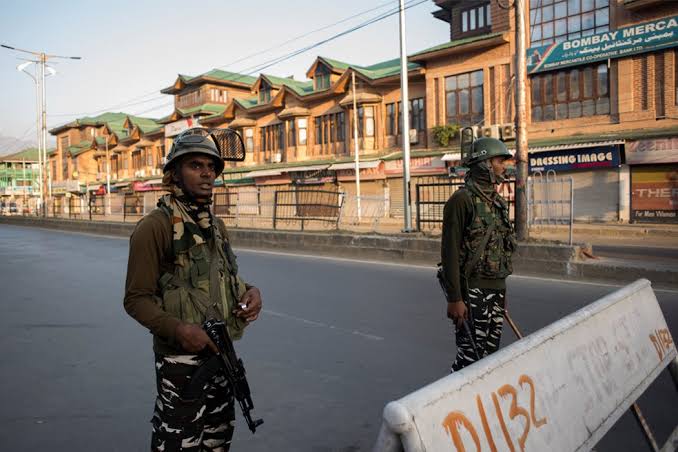
The security environment changed significantly after 2019. Following the constitutional changes of August that year, security and investigative agencies intensified action against terrorist networks, terror financing, separatist organisations and their support structures. Ministry of Home Affairs figures recorded 417 terrorist incidents in Jammu and Kashmir in 2018, compared with 255 in 2019, 244 in 2020 and 229 in 2021. Parliamentary records also showed reductions in civilian and security-force deaths during the period following 5 August 2019 compared with the preceding period. These figures do not mean that terrorism disappeared, but they indicate a changing security environment in which the information domain acquired greater importance. The smartphone has transformed this battlefield. A militant requires movement, logistics and infrastructure; a narrative requires only connectivity. A rumour that once travelled through a marketplace can now cross Kashmir, Pakistan, India and the wider world within minutes. An old photograph can be presented as a recent event, a video from another country can be falsely attributed to Kashmir, or a fabricated statement can be presented as the words of a public official.
The objective is not always to persuade people to support a particular political position. It can also be to weaken trust in institutions, deepen social divisions, amplify uncertainty and create the impression that instability is unavoidable. During a security incident, an unverified video can spread faster than authorities can establish the facts. Once an emotionally powerful narrative takes hold, correcting it becomes much harder. Artificial intelligence has added another dimension. Deepfakes, synthetic voices and manipulated images can create convincing events or statements that never existed. At the same time, genuine evidence may increasingly be dismissed as fabricated. This makes information resilience essential.
For Jammu and Kashmir, the long-term response requires rapid access to verified information, credible journalism, digital literacy and effective mechanisms for identifying manipulated content. Citizens can also strengthen resilience by asking simple questions before forwarding information: Who produced it? When and where was it recorded? Is there independent confirmation? What does the original source actually say? The contest over Kashmir has therefore entered a new phase. Conventional military force, terrorism, radicalisation and propaganda remain part of the broader security environment, but digital technology has created a frontier where geography offers limited protection. The Line of Control can restrict the movement of a person; it cannot easily restrict the movement of an idea. As physical security improves, the struggle over perception is likely to remain important. The next battlefield may not always be defined by territory. It may be defined by information and by what people choose to believe, verify and share