


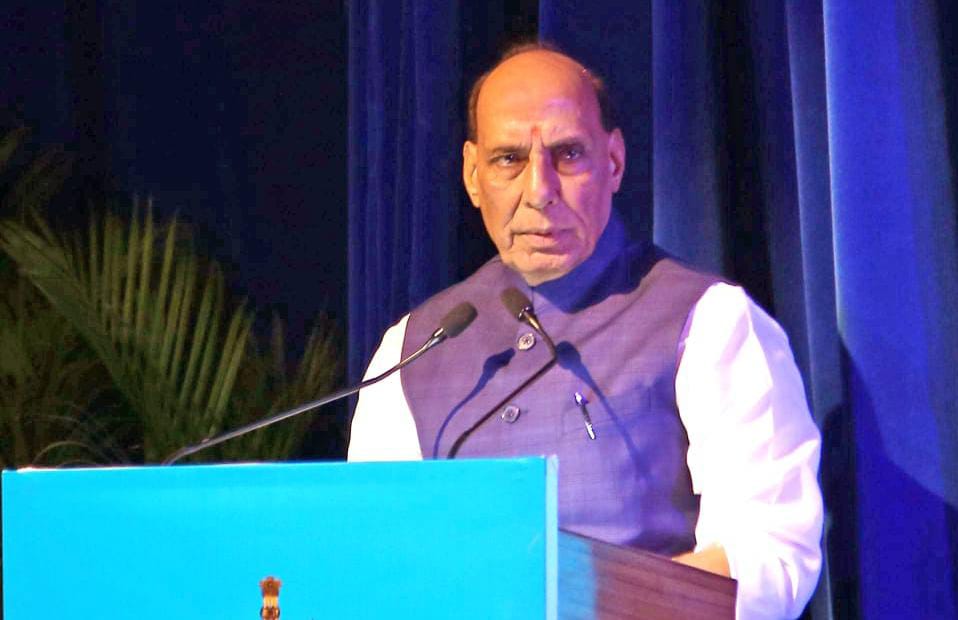
New Delhi, Sep 30 (JKNS): Defence Minister Rajnath Singh declared on Tuesday, praising the unprecedented real-time coordination between the Army, Navy and Air Force during the mission saying that the “Operation Sindoor must be the benchmark for every future operation.”
He said jointness among the services is “not merely a policy goal, but a necessity for survival in today’s security environment.”


Defence Minister Rajnath Singh during a seminar organised by the Indian Air Force (IAF) at Subroto Park, as per news agency JKNS said, “During Operation Sindoor, the tri-services synergy produced a unified, real-time operational picture. It empowered commanders to take timely decisions, enhanced situational awareness, and reduced the risk of fratricide. This is the living example of jointness delivering decisive results and this success must become the benchmark for all future operation.”
He further highlighted the importance of IAF’s Integrated Air Command and Control System (IACCS), working in unison with the Indian Army’s Akashteer and the Indian Navy’s Trigun, making a joint operational backbone during the operation.
The seminar on the theme ‘Fostering Greater Jointness – Synergy through Shared Learning in the domain of Inspection and Audits, Aviation Standards and Aerospace Safety’ underscores the necessity for India’s Armed Forces to embrace deeper integration to meet the demands of modern warfare and to maximize defence preparedness.
Raksha Mantri stated that the evolving character of warfare, combined with the complex interplay of traditional and non-traditional threats, makes jointness a core operational necessity rather than a matter of choice. “Jointness has become a fundamental requirement for our national security and operational effectiveness today. While each of our services possesses the capacity to respond independently, the interconnected nature of land, sea, air, space and cyberspace makes collaborative strength the true guarantor of victory,” he added.
Shri Rajnath Singh recalled the recent Combined Commanders’ Conference held in Kolkata where the Prime Minister Shri Narendra Modi himself had underlined the importance of jointness and integration. He further stated that this reflects the Government’s clear commitment to ensuring that the Armed Forces are not only among the best in the world in terms of values and traditions but also pioneers of future-ready systems. “Our government’s objective is to further promote Jointness and integration among the Tri-Services. This is not only a matter of policy but a matter of survival in the fast-changing security environment,” he underlined.
Highlighting the strides made in the digital domain, the Raksha Mantri praised the Army’s Computerised Inventory Control Group (CICG), the Air Force’s Integrated Materials Management Online System (IMMOLS), and the Navy’s Integrated Logistics Management System. He said these have already transformed logistics by bringing automation, accountability and transparency. He announced that work has begun on the Tri-Services Logistics Application, which will integrate these systems to provide shared visibility of stocks, optimise cross-service resources and reduce redundant procurement.
Shri Rajnath Singh explained that over decades, each service had developed operational practices, inspection frameworks and audit systems based on their distinct experiences across geographies. He paid tribute to the Armed Forces’ resilience in operating in diverse conditions from snow-clad peaks to deserts, dense forests, deep seas, and open skies while pointing out that such hard-won knowledge often remained confined within a single service. “If the Army developed something, it remained with the Army. If the Navy or Air Force developed something, it remained within their own walls. This compartmentalisation has limited the cross-sharing of valuable lessons,” he observed.
Raksha Mantri urged that in today’s security climate, such compartmentalisation must give way to open sharing and collective learning. “The world is changing rapidly. Threats have become far more complex and we must acknowledge that no single service can operate in isolation. Interoperability and jointness are now essential for success in any conflict,” he said.
Shri Rajnath Singh warned that in critical domains such as aviation safety and cyber warfare, divergence in standards could prove disastrous. “Even a minor error in inspection can create cascading effects. And if our cyber defence systems differ across services, adversaries can exploit the gap. We must close these vulnerabilities by harmonising our standards,” he stated. At the same time, Shri Rajnath Singh stressed that integration must respect the uniqueness of each force. “The cold of the Himalayas is not the same as the heat of the desert. The Navy faces challenges different from the Army and Air Force. We cannot impose uniformity where it does not fit. Our task is to create a shared baseline that preserves uniqueness while building interoperability and trust,” he explained.
Raksha Mantri further stressed that achieving jointness requires not just structural reform but also a change in mindset. He called upon senior leadership at all levels to continuously communicate the value of integration to their teams. He recognised that such change will not be easy and will involve overcoming legacy habits and institutional silos. “We will face challenges as we move towards Jointness. But through dialogue, understanding and respect for traditions, we can overcome these hurdles. Every service must feel that the others understand their challenges, and every tradition must be honoured as we build new systems together,” he highlighted.
Shri Rajnath Singh urged the Armed Forces to continue studying international best practices and adapt them to India’s context. “We can learn from others, but our answers must be Indian answers shaped by our geography, our needs and our culture. Only then can we build systems that are truly sustainable and future-ready,” he added.
Raksha Mantri reiterated the government’s commitment to supporting Jointness in every possible way and called upon all services and institutions including the Indian Coast Guard (ICG), Border Security Force (BSF) and Directorate General of Civil Aviation (DGCA) to move decisively on this path. “Only when our Armed Forces operate in unison, in harmony, and in perfect coordination can we counter adversaries across all domains and lead India to new heights of glory. This is the need of the hour, and I am confident we will achieve it,” he underlined.
Before his address, Shri Rajnath Singh paid condolences to Director General Territorial Army Lieutenant General Raju Baijal who passed away this morning.
Chief of Defence Staff General Anil Chauhan, Chief of the Naval Staff Admiral Dinesh K Tripathi, Chief of the Air Staff Air Chief Marshal AP Singh, Director General (Inspection and Safety) Air Marshal Makarand Ranade, senior officials of Armed Forces, ICG, BSF, DGCA and veterans were present on the occasion.
Key outcomes of the seminar were consensus on the need for greater commonality in inspection processes and exploration of opportunities to enhance interoperability amongst Services in aviation. Session on Joint Aerospace Safety highlighted the importance of a unified approach to enhance safety standards and address emerging challenges. The seminar concluded as a prominent step towards enhanced collaboration and sharing of expertise. (JKNS)