


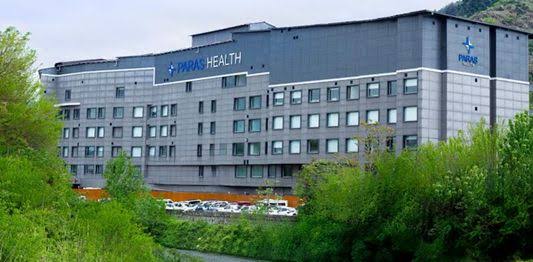
At 82, she faced a 102 sodium level and a brain tumour: PARAS Srinagar team took surgical challenge


82-year-old woman undergoes high-risk pituitary tumour surgery despite severe hyponatraemia, pacemaker and blood thinners
Srinagar, September 30, 2026: In a high-risk neurosurgical intervention, doctors at PARAS Health Srinagar have successfully removed a complex pituitary tumour from an 82-year-old woman who presented with sudden loss of vision, severe headache and altered sensorium.
The case was particularly challenging as the patient had a pacemaker, was on blood-thinning medication and had severe hyponatraemia, with her sodium level recorded at 102 at admission.
MRI revealed a pituitary macroadenoma with apoplexy, a potentially life-threatening complication involving bleeding or infarction within a pituitary tumour.
The patient was managed by a multidisciplinary team led by Dr Basharat Kanth, Consultant Neurosurgery, and Dr Danish Andrabi, Director, ENT & Endoscopic Skull Base Surgery, with the support of the Department of Endocrinology, Cardiology, Anaesthesia, Critical Care and ENT.
Doctors said the patient had previously been evaluated at a government institution, where surgery was considered unsuitable in her prevailing condition.
At PARAS, the immediate priority was to stabilise her medically. Under the care of Dr Mehroosa, Endocrinology, her severe electrolyte imbalance was corrected over five days, allowing the surgical team to proceed after adequate optimisation.
Given her cardiac history and blood-thinner use, the patient was also evaluated and optimised by the Department of Cardiology, including Dr Fayaz, Principal Consultant, Cardiology, as part of the pre-operative multidisciplinary assessment.
The tumour was subsequently removed completely through an extended endoscopic transsphenoidal approach, a minimally invasive skull-base technique that provides access to the pituitary region through the nasal passage.
Dr Danish Andrabi said the patient’s advanced age and multiple medical risk factors made the procedure particularly demanding.
“This was an extremely challenging case given the patient’s age, severe hyponatraemia, cardiac history and use of blood thinners. Once she was adequately stabilised, we decided to take up the surgical challenge.”
He said the tumour was firm and closely related to critical structures, including the carotid and cavernous areas.
“With meticulous dissection, we were able to achieve complete removal of the tumour and decompress the optic chiasm,” Dr Andrabi said.
The ENT and Endoscopic Skull Base Surgery team played a key role in providing the endoscopic surgical access and skull-base expertise required for the procedure.
The patient was successfully extubated immediately after surgery by the Anaesthesia team. Doctors said she developed neither cerebrospinal fluid (CSF) leakage nor diabetes insipidus—recognised complications following pituitary surgery.
She was discharged three days after the procedure in a stable condition, with significant improvement in her vision and resolution of her headache.
Dr Basharat Kanth, Consultant Neurosurgery, said the case demonstrated that advanced age and multiple co-morbidities can require careful optimisation rather than automatically precluding complex neurosurgical intervention.
Dr Murtuza Habib, Facility Director, PARAS Health Srinagar, said the outcome reflected close coordination across multiple departments.
“Treating an 82-year-old patient with such complex medical and neurosurgical challenges required meticulous preparation and seamless coordination between neurosurgery, ENT, endocrinology, cardiology, anaesthesia and critical care. The successful outcome reflects the expertise and teamwork of the entire clinical team.”
Seema Vig, Senior Vice President and Regional Director, PARAS Health, said the case highlighted the growing availability of specialised healthcare in the region.
“Complex cases such as this require not only specialised surgical expertise but also the ability to stabilise and manage patients before and after surgery. This successful outcome reflects our commitment to providing advanced and comprehensive care closer to patients in the region.”
The hospital also acknowledged the contribution of the Anaesthesia, Operation Theatre and ICU teams, whose peri-operative management was critical to the patient’s safe recovery.
The case was described by the treating team as a significant multidisciplinary achievement, combining neurosurgery, endoscopic skull-base surgery, endocrinology, cardiology, anaesthesia and critical care in the management of a high-risk elderly patient.”