

Dr. Rashid

When ballots are cast amid violence, public anger and disputed representation, the deeper crisis is not simply about an election but about who truly has a voice in the future of the territory
Dr.Rashid [email protected]
There are moments when an election becomes more than an exercise in choosing representatives. It becomes a mirror. In Pakistan occupied Kashmir, that mirror is reflecting a deeply troubled political and social reality.As voting began on Monday in the first phase of the legislative assembly elections, the process was overshadowed by violence, allegations of irregularities and continuing public anger. Polling opened across constituencies in the Mirpur division, but the atmosphere was far removed from the image of a peaceful and well governed territory that Pakistan seeks to project.
Instead, the election unfolded against a backdrop of protests, clashes and a growing sense of alienation among sections of the local population.The first phase itself was marked by violence. A political worker was killed in Kotli amid clashes involving supporters of rival parties, while allegations of electoral manipulation and disruption were reported from polling areas. Authorities extended voting hours in some constituencies following disturbances. These incidents have raised fresh questions about whether the electoral process can genuinely represent the will of the people when public confidence in political institutions is already under severe strain.
“A democracy cannot be measured by the presence of a ballot box alone. It must be measured by whether people are free to speak, vote and demand accountability without fear”
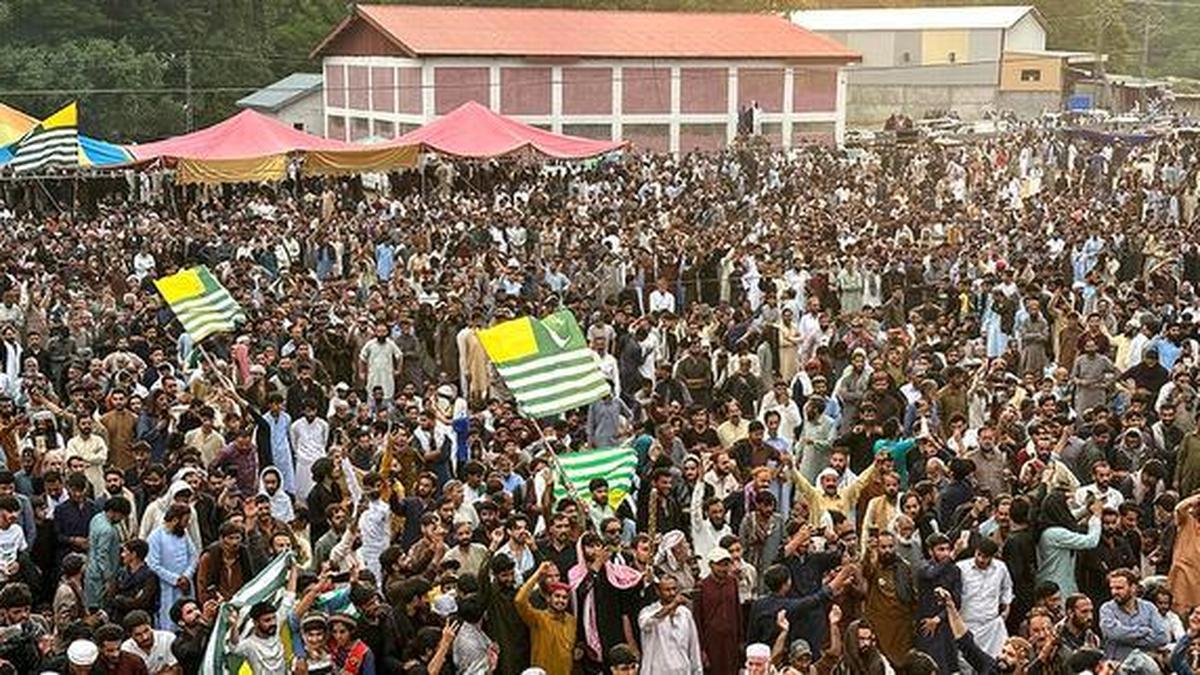
But the election day violence is only the latest chapter in a much larger story.For months, public dissatisfaction has been building across Pakistan occupied Kashmir. At the centre of the movement is the Joint Awami Action Committee, an alliance that has brought together traders, transporters, students, lawyers and other sections of civil society. Its protests began around economic pressures and public services but gradually expanded into a broader challenge to the region’s political system.
One of the most contentious demands concerns the twelve seats in the legislative assembly reserved for refugees. Protesters argue that these seats allow people living outside the territory to influence political outcomes inside it. For residents who believe that their own future should be decided by those who live there, the arrangement has become a powerful symbol of political marginalisation.The issue has now moved far beyond political debate.After talks with the authorities failed, thousands of protesters resumed mobilisation towards Muzaffarabad. Clashes followed as security forces attempted to prevent the march from advancing. Different sides have offered competing accounts of what happened, but the scale of the violence has been impossible to ignore. Reports of deaths and injuries have deepened public anger, while authorities have moved against the protest organisation and restricted its activities.
The United Nations has also expressed concern. UN High Commissioner for Human Rights Volker Türk called for prompt, thorough and impartial investigations into deaths involving both civilians and security personnel. The UN has also urged meaningful and inclusive political dialogue to address the grievances of the local population.That international concern matters because the unrest cannot simply be dismissed as a law and order problem.Behind the demonstrations lies a catalogue of long standing grievances. People have repeatedly complained about high prices, taxation, electricity shortages, inadequate supplies and economic hardship. Earlier protests have also highlighted questions of political representation, governance and the distribution of resources. The continuation of these grievances from one protest movement to another suggests that the authorities have repeatedly treated symptoms while avoiding the underlying causes.
The deeper contradiction is difficult to overlook. Pakistan presents the territory as a democratic and autonomous part of its political system. Yet when ordinary residents question the structure of representation, challenge economic policies or demand greater accountability, the response has increasingly involved restrictions, arrests, security deployments and, according to rights officials and protest groups, excessive force.This raises an uncomfortable question: what does self government mean if the people living in a territory feel that important political decisions are shaped elsewhere?The controversy over reserved seats is therefore not merely an electoral technicality. It goes to the heart of representation. A legislature can have elected members and still fail to inspire confidence if sections of the population believe that the system is designed to dilute their political voice.
The same concern extends to economic resources. Pakistan occupied Kashmir has significant natural wealth and strategic importance, yet many residents continue to complain that they have not received an equitable share of the benefits. In neighbouring Gilgit Baltistan, disputes over resource extraction and local consent have added to wider concerns about control, ownership and economic justice.India has consistently maintained that Pakistan occupied Kashmir is an integral part of India and remains under Pakistan’s illegal occupation. From New Delhi’s perspective, the current unrest demonstrates the consequences of decades of political marginalisation and exploitation. The continuing turmoil has given renewed force to that argument.
Yet beyond competing national positions, there is a more immediate human question.What do the people living there want?The answer cannot be obtained through force, censorship or elections conducted under a cloud of fear. It requires genuine political dialogue, transparent institutions, credible elections and respect for the rights of ordinary citizens.The events surrounding the current election have therefore exposed something much larger than electoral disorder. They have exposed the widening gap between official claims of democracy and the lived experience of many people in Pakistan occupied Kashmir.An election is meaningful only when people believe their vote matters, their voice is heard and their representatives are accountable to them.If those conditions are absent, the ballot box becomes little more than a symbol.And the unrest in Pakistan occupied Kashmir suggests that increasingly, the people are demanding something more substantial than symbols. They are demanding dignity, representation, accountability and a meaningful say in their own future.