


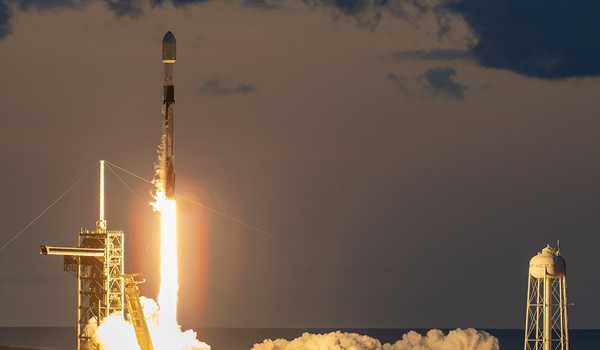
Chennai: ISRO’s first ever rocket mission launch of GSAT-N2, an advanced communication satellite to enhance inflight connectivity, from Elon Musk-owned SpaceX’s Falcon -9 rocket in US was a tremendous success on Monday night/Tuesday morning (IST).
The rocket, carrying the 4,700 kg satellite, in an exclusive commercial mission and the first from


SpaceX’s Cape Canaveral launch station, the 70 m tall vehicle took off majestically at 0012 hrs
after a smooth countdown.
After a flight duration of about 33 minutes and after the first stage of the vehicle
landed on the Just Read the Instructions droneship, stationed in the Atlantic Ocean,
the satellite was injected in to the GEO.
ISRO till now relied on Ariane Rocket for its heavy weight GSAT launches from Kourou in French Guyana.
Since it has stopped launching sequences, it tied up SpaceX by the Indian government’s New Space India Limited (NSIL), ISRO’s commercial arm for this exclusive commercial launch.
According to SpaceX in a post on X, the launch success was confirmed.
Amid clear skies, the rocket lifted off from the second Pad of Space Launch Complex 40 (SLC-40) at
Cape Canaveral Space Force Station in Florida, US and injected the satellite into the GTO precisely.
This isthe 19th flight for the Falcon 9 first stage booster supporting this mission, which previously launched SES-22, ispace’s HAKUTO-R MISSION 1, Amazonas-6, CRS-27, Bandwagon-1, and 13 Starlink missions.
After stage separation, the first stage landed on the Just Read the Instructions droneship, which
was stationed in the Atlantic Ocean.
GSAT-20 (also known as CMS-03 or GSAT-N2) is a communication satellite, ISRO said.
Though ISRO’s LMV-3 which has the capacity to launch satellites weighing up to 4,000 kg into the GTO, the Indian Space Agency chose to launch it using SpaceX’s Falcon-9 launch vehicle from US, as it weighed 4,700 kg.
This is ISRO’s first ever commercial launch using SpaceX.
The GSAT-20, funded, owned and operated by NSIL, is a continuation of GSAT series of communication satellites and is intended to add data transmission capacity to the communication infrastructure required by Smart Cities Mission of India.
The entire capacity onboard CMS-02 satellite will be leased to Dish TV.
GSAT-N2 (GSAT-20) is a Ka-band High throughput communication satellite of NewSpace India Limited (NSIL), a Government of India company under the Department of Space and the commercial arm of ISRO. GSAT-N2 is the 2nd Demand Driven satellite of NSIL.
GSAT-N2 is set to enhance broadband services and in-flight connectivity (IFC) across the Indian region.
This satellite, featuring multiple spot beams and wideband Ka x Ka transponders, aims to support a large subscriber base with small user terminals, significantly boosting system throughput through its multi-beam architecture which allows frequency reuse.
GSAT-N2, with a lift-off mass of 4700 kg, has a mission life of 14 years.
The satellite is equipped with 32 user beams, comprising 8 narrow spot beams over the Northeast region and 24 wide spot beams over the rest of India. These 32 beams will be supported by hub stations located within mainland India. The Ka-Band HTS communication payload provides a throughput of approximately 48 Gbps.
The payload consists of three parabolic 2.5-meter deployable reflectors with multiple feeds generating 32 spot beams over the Indian region using a single feed per beam configuration.
The GSAT-N2 spacecraft structure is based on the standard Carbon Fiber Reinforced Polymer (CFRP)-based I4K bus. GSAT-N2 is compatible with all major launch vehicles. The thermal control configuration includes both active elements, such as heat pipes and heaters, and passive elements, like multi-layer insulation (MLI) blankets, optical solar reflectors (OSR), thermal paints, and coatings, as used in earlier missions.
The Solar Array deployment mechanisms on the North and South sides of the spacecraft are used
for the deployment of N&S Solar arrays. Each Ka-band antenna is equipped with Deployment and Pointing mechanisms for in-orbit deployment and precise pointing of the antennae.
The propulsion system of GSAT-N2 is configured with a unified bi-propellant chemical propulsion system employing MON3 as oxidizer and MMH as fuel. GSAT-N2’s power system is a single fully regulated 70V bus, consisting of solar panels for power generation, Li-Ion batteries for energy
storage and peak load support, and power electronics for power conditioning and distribution.
The electrical power system is designed to meet a power requirement of approximately 6 kW.
The Attitude and Orbit Control System (AOCS) uses a body-stabilized, momentum-biased system with momentum/reaction wheels to provide a stable platform for communication. Together with the propulsion subsystem, AOCS offers the capability of 3-axis attitude control using thrusters in the transfer orbit as well as orbit raising and fine orbit corrections.
The satellite carries a Sun Sensor, Earth Sensor, Inertial Reference Unit (IRU), and Star Sensor.
All sensors provide attitude data in the form of absolute attitude, while the IRU provides attitude
rates and incremental angles about all the axes.
UNI