


Peerzada Sayeed
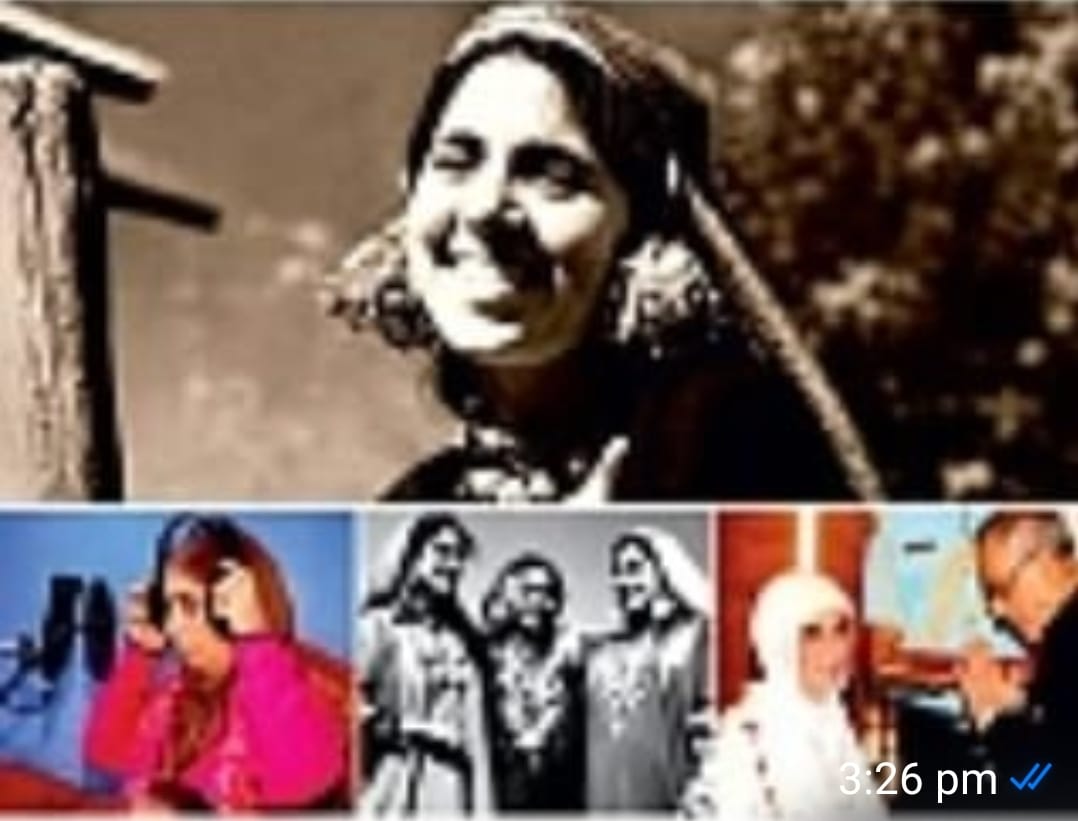
Whenever folk music and Sufi poetry are discussed in the valleys of Kashmir, an image of a voice arises that not only illuminated the soil of Kashmir with the emotive power of its singing, but also enlightened the souls of listeners. This voice belonged to Kashmir’s beloved “Nightingale of Kashmir,” Raj Begum, who was born on March 27, 1927, in a traditional household in Srinagar.


Raj Begum’s life and art stand as proof that when someone is blessed with the magic of music by nature alongside hard work, that personality transcends the boundaries of time to live on forever. Her early days were filled with domestic constraints much like any ordinary woman of that era, as women singing openly or participating in musical gatherings was not easily accepted. However, her beloved father recognized her artistic talent and offered her immense encouragement.
Raj Begum not only broke traditional boundaries but also gave a new color and life to Kashmiri folk music and classical poetry. Her singing style was distinct, deeply moving, and close to nature. When she sang the poetry of Mahjoor, Mahmud Gami, and other renowned poets, it felt as though a new resonance was sweeping through the valleys, casting a spell on all who listened. Her voice possessed a magic that won the hearts of both ordinary people and the elite alike.
Though Raj Begum is no longer in this world today, the unforgettable life story of this queen of melody—who shattered traditional constraints to give new life to Kashmiri folk music and classical poetry—has become immortal. Her name will forever shine brightly in the history of Kashmir’s civilization and culture.
A Journey from an Ordinary Household to an Extraordinary Status
Raj Begum was born on March 27, 1927, in the Magarmal Bagh area of Srinagar. Her original name is said to have been Rihti. She belonged to a simple and traditional family. From a young age, she had a passion for singing, and her voice possessed a natural allure. Her father, Ghulam Rasool Sheikh, recognized her talent and encouraged her.
In her early life, she used to sing at local wedding ceremonies. Her voice drew people’s attention during these events, but the social environment of that era was far from favorable for women advancing in the field of vocal art.
This was a time when a woman singing publicly in conservative Kashmiri society was considered an extraordinary matter. Even a woman presenting her voice on the radio could invite social criticism and opposition. In such an environment, Raj Begum’s decision to move forward was not merely a personal desire, but an expression of social courage.
A New Chapter Beginning from Radio Kashmir
A major turning point in Raj Begum’s life arrived when the renowned musician and sarangi player Ghulam Qadir Langoo heard her voice and played a pivotal role in introducing her to Radio Kashmir.
In 1954, she officially began her musical journey through Radio Kashmir. The social difficulties, criticism, and opposition she faced initially bear witness to how challenging it is to establish a new tradition in any society.
Yet, Raj Begum did not lose heart. She made her art her identity and surmounted all obstacles that stood in the path of women in the fine arts.
Her success was not just a personal victory; it opened a new path for other women in Kashmir. She proved that a woman’s capability cannot be restricted by social prejudices.
This is precisely the point where an artist moves beyond individual identity to become a civilizational symbol for an entire nation.
Beyond Awards: A Great Heritage
Raj Begum’s artistic services were also recognized at the national level. She was honored with India’s prestigious civilian award, the Padma Shri, in 2002, and received the Sangeet Natak Akademi Award in 2013.
These accolades served as an acknowledgment of her long artistic struggle and her contributions to Kashmiri music.
Even after retiring from the radio in 1986, the impact of her voice did not fade. Her songs lived on through preserved radio recordings, musical gatherings, and the memories of the people.
On October 26, 2016, she passed away in Srinagar at the age of 89. Her departure certainly marked the end of an era in Kashmiri music, but her art remains alive today.
Raj Begum’s Message for Today’s Kashmir
Today, when we speak of connecting the younger generation of Kashmir with their language, literature, culture, and civilizational identity, the importance of personalities like Raj Begum grows manifold.
It is a moment for introspection: how much value do we accord during their lifetimes to the artists, writers, poets, and cultural figures who spend their entire lives preserving our civilizational identity?
It is our misfortune that we often realize the worth of our great people only after they are no longer among us. Ceremonies are held in their memory, articles are written, and their achievements are recounted, but consistent and serious efforts to pass on their art to the new generation remain sparse.
Raj Begum’s life teaches us that art is not merely a source of entertainment, but a powerful medium to preserve a nation’s history, language, and identity.
There is an urgent need to preserve her songs and the rare compositions of other Kashmiri artists, organize special programs regarding Kashmiri language and culture in schools and educational institutions, and promote research work on the lives of such artists.
A Voice That Will Never Fall Silent
Though Raj Begum is no longer physically among us, her voice remains alive in every Kashmiri heart that loves its language, its soil, and its culture.
She was a woman who raised her voice at a time when expressing one’s talents was not easy for women in society. She did not let opposition become her weakness; instead, through her hard work, dedication, and art, she turned it into the path to her success.
Her life stands witness to the truth that greatness is not achieved through high titles or superficial fame, but through what a person leaves behind for future generations.
Raj Begum did not merely give songs to Kashmir; she gave a voice that became an integral part of Kashmiris’ joys, sorrows, loves, and memories.
Time will pass, generations will change, and radio voices will evolve, but whenever there is talk of experiencing the emotions of love, separation, and life in the Kashmiri language, Raj Begum’s name will be taken with the utmost respect.
Because certain voices do not fall silent even after death; they step out of the pages of history to echo in the hearts of generations.
Contact No: +918491070608