

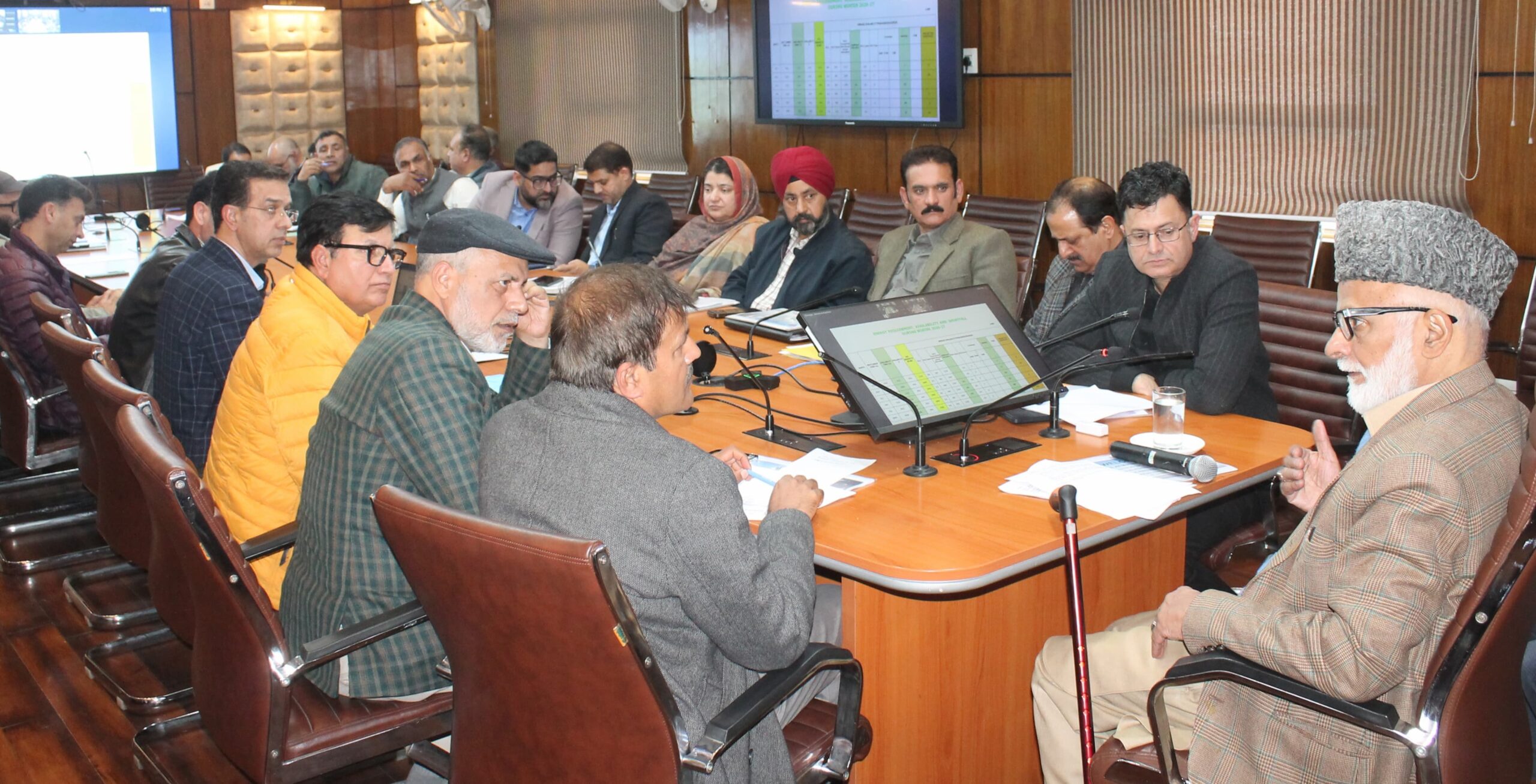
SRINAGAR, OCTOBER 30: Minister for Revenue, Power Development Department (PDD), Law, Disaster Management, Relief, Rehabilitation and Reconstruction (DMRRR), and Elections, Ali Mohammad Sagar, today unsertook a review meeting of the Power Development Department at the Civil Secretariat to take stock of its overall functioning, assess preparedness for the forthcoming winter season and review key initiatives and infrastructure projects aimed at strengthening the power sector and improving electricity services across Jammu and Kashmir.


The meeting was attended by Managing Directors of all power corporations, Director Finance, Power Development Department, Special Secretary to Government (S/P), Director Planning, Additional Secretaries (A/Z and Legal), Chief Engineers, Superintending Engineers and Executive Engineers of KPDCL, JPDCL, JKPTCL, JKPCL and JKPDCL, besides Chief Electrical Inspector and other senior officers and concerned field functionaries of the department. Officers based in Jammu participated in the meeting through virtual mode.
During the meeting, the officers apprised the Minister of the overall functioning of the department, progress on ongoing developmental works, power generation and procurement arrangements, transmission and distribution infrastructure, financial performance, operational challenges and future requirements.
Emphasising that reliable, affordable and quality electricity is an essential public service, the Minister said that the ultimate objective of every departmental initiative must be to ensure improved power supply and better consumer satisfaction. He stressed that administrative efficiency, timely execution of projects and effective coordination at all levels must translate into visible improvements in public service delivery.
Reviewing preparedness for the forthcoming winter season, Sagar stressed the need for comprehensive advance arrangements to ensure reliable power supply, particularly in snow-bound, far-flung, hilly and remote areas. He directed officers to maintain adequate stocks of transformers, cables, conductors and other essential equipment at strategically identified locations to facilitate immediate restoration of electricity in case of breakdowns and emergencies.
He emphasised that winter preparedness must be reflected in tangible arrangements on the ground and called for regular inspection of vulnerable infrastructure, identification of potential bottlenecks and deployment of adequate technical manpower and machinery. He also directed the concerned officers to strengthen field-level response mechanisms and ensure effective coordination among different wings of the department for speedy restoration of electricity during adverse weather conditions.
The Minister underscored that uninterrupted power supply to essential services, including hospitals, healthcare centres, drinking water installations, educational institutions and other critical public utilities, must receive priority, particularly during periods of heavy snowfall and inclement weather.
The status of the electricity amnesty scheme was also reviewed, with the Minister emphasising that its intended benefits must reach all eligible consumers. He called for simplified procedures, effective public outreach and timely disposal of cases to facilitate people in availing the benefits of the scheme without unnecessary difficulties.
Taking stock of the overall power availability and demand-supply position, the Minister discussed the requirement for additional power procurement, including the proposed procurement of approximately 200 MW from Uttar Pradesh through power exchange arrangements to bridge the demand-supply gap. He stressed the importance of advance assessment of electricity requirements and timely procurement planning to ensure adequate power availability, particularly during peak winter demand.
Reviewing the progress under the Revamped Distribution Sector Scheme (RDSS), Sagar called for expediting works aimed at strengthening the distribution network, replacing overloaded transformers and other equipment, improving feeder infrastructure and reducing technical and commercial losses. He directed the officers to closely monitor the execution of these works so that the intended benefits of the scheme are translated into improved electricity supply and enhanced consumer satisfaction.
The Minister also reviewed the status of smart meter installation across Jammu and Kashmir and stressed that technological interventions should promote transparency, accurate billing, accountability and improved consumer services. He observed that the adoption of modern technology must strengthen public confidence in the power distribution system and called for addressing consumer concerns through proper communication, awareness and responsive grievance redressal mechanisms.
The existing power generation capacity, availability of electricity and possibilities of optimising available resources were also discussed. The Minister stressed the need to explore all feasible avenues for enhancing generation, improving operational efficiency and ensuring better utilisation of available power resources. He also reviewed the status of transmission lines, grid stations, capacity enhancement and maintenance works, directing officers to identify infrastructure gaps, remove bottlenecks and expedite necessary interventions to strengthen the transmission network and improve the reliability of power supply.
Emphasising the need to improve the financial and operational health of the department, Sagar reviewed billing efficiency, revenue collection and measures for reducing Aggregate Technical and Commercial (AT&C) losses. He stressed that improved revenue realisation and financial discipline were important for the sustainability of the power sector; however, these objectives must go hand in hand with better consumer services, transparency and accountability. He called for strengthening institutional mechanisms to ensure accurate metering, timely billing and efficient revenue collection while safeguarding the interests of genuine consumers.
The Minister directed the officers to adopt a consumer-friendly approach and ensure that complaints relating to unscheduled power cuts, faulty transformers, damaged distribution lines, low voltage and delayed restoration of electricity are addressed promptly. He stressed that scheduled shutdowns must be communicated to consumers well in advance so that people can plan their activities accordingly. He further called for strengthening complaint-monitoring mechanisms and ensuring that officers remain accessible and responsive to public grievances, particularly during the winter months.
The long-pending issues concerning PDL and CLW workers engaged with the Power Development Department also received particular attention during the meeting. The Minister emphasised the need to evolve a fair, transparent and time-bound mechanism for examining their cases, observing that their services, experience, contribution and years of association with the department deserve due consideration.
He directed the concerned authorities to examine their cases in accordance with applicable government policies, rules and eligibility conditions and formulate an appropriate roadmap for their job security, rehabilitation and regularisation, wherever permissible under the rules. He observed that these workers have contributed significantly towards maintaining essential power services, often under difficult and challenging field conditions, and stressed that their long-pending concerns should be addressed with sensitivity and seriousness to arrive at a dignified and sustainable solution.
The Minister also undertook a detailed review of major power projects presently under execution as well as those in the pipeline. Stressing that timely completion of these projects was essential for strengthening the power sector, he directed the officers to closely monitor their progress, ensure effective inter-departmental coordination and remove administrative, technical and execution-related bottlenecks.
He observed that investments in the power sector must translate into enhanced power generation capacity, improved transmission and distribution infrastructure, greater energy security and sustainable long-term benefits for the people of Jammu and Kashmir. The officers were directed to undertake regular progress reviews, adhere to prescribed project timelines and ensure optimum utilisation of available resources without compromising the quality of execution.
Highlighting the importance of coordination between the administrative machinery and elected representatives, the Minister directed field officers to maintain regular and meaningful interaction with MLAs, elected public representatives and village heads, irrespective of their political affiliations. He said that public representatives are important stakeholders in the governance process and their feedback, suggestions and assessment of local requirements must receive due consideration while identifying infrastructure gaps, addressing area-specific problems and resolving public grievances.
He stressed that effective coordination at the grassroots level would help the department identify local requirements, improve its response mechanism and ensure that electricity-related concerns of people are addressed in a timely and satisfactory manner.
The Minister also emphasised the need to explore innovative and sustainable approaches towards energy conservation, promotion of renewable energy, solar power adoption, feeder-level monitoring and efficient utilisation of available resources. He called for greater public awareness regarding responsible electricity consumption and energy conservation, observing that sustainable energy practices would contribute towards strengthening the power sector in the long run.
Sagar observed that the department must move beyond routine administrative functioning and adopt a proactive, accountable and result-oriented approach. He stressed that senior officers must regularly monitor the performance of their respective wings and ensure that directions issued at the administrative level are effectively implemented by field functionaries. He also called for strengthening coordination among different wings of the department to ensure that operational challenges are addressed through timely and coordinated interventions.
The Minister reiterated that electricity is an essential public service and its benefits must reach every household, irrespective of geographical location or economic background. He emphasised that particular attention must be given to remote, hilly, snow-bound and underserved areas so that people residing in these regions do not face avoidable hardships due to inadequate infrastructure or delayed restoration of power supply.
He further stressed that the performance of the department should not be assessed merely through the number of projects completed or expenditure incurred, but primarily through the actual improvement experienced by consumers in terms of reliability, accessibility, transparency and quality of electricity services.
The meeting concluded with a renewed emphasis on strengthening coordination between the administrative leadership, field functionaries and elected public representatives to ensure effective implementation of departmental policies and government initiatives.
Reiterating his commitment towards strengthening the power sector, Sagar stressed that making the Power Development Department more efficient, transparent, accountable and people-friendly, while ensuring reliable electricity supply, timely completion of infrastructure projects and responsive consumer services, would remain a key priority. He called upon all officers and field functionaries to work with dedication, commitment and a strong sense of public responsibility to meet the expectations of the people of Jammu and Kashmir.
The meeting was attended by Managing Directors of the power distribution and transmission corporations, Director Finance, Power Development Department, Special Secretary to Government (S/P), Director Planning, Additional Secretaries (A/Z and Legal), Chief Engineers, Superintending Engineers and Executive Engineers of KPDCL, JPDCL, JKPTCL, JKPCL and JKPDCL, besides the Chief Electrical Inspector and other senior officers and concerned field functionaries of the department.