


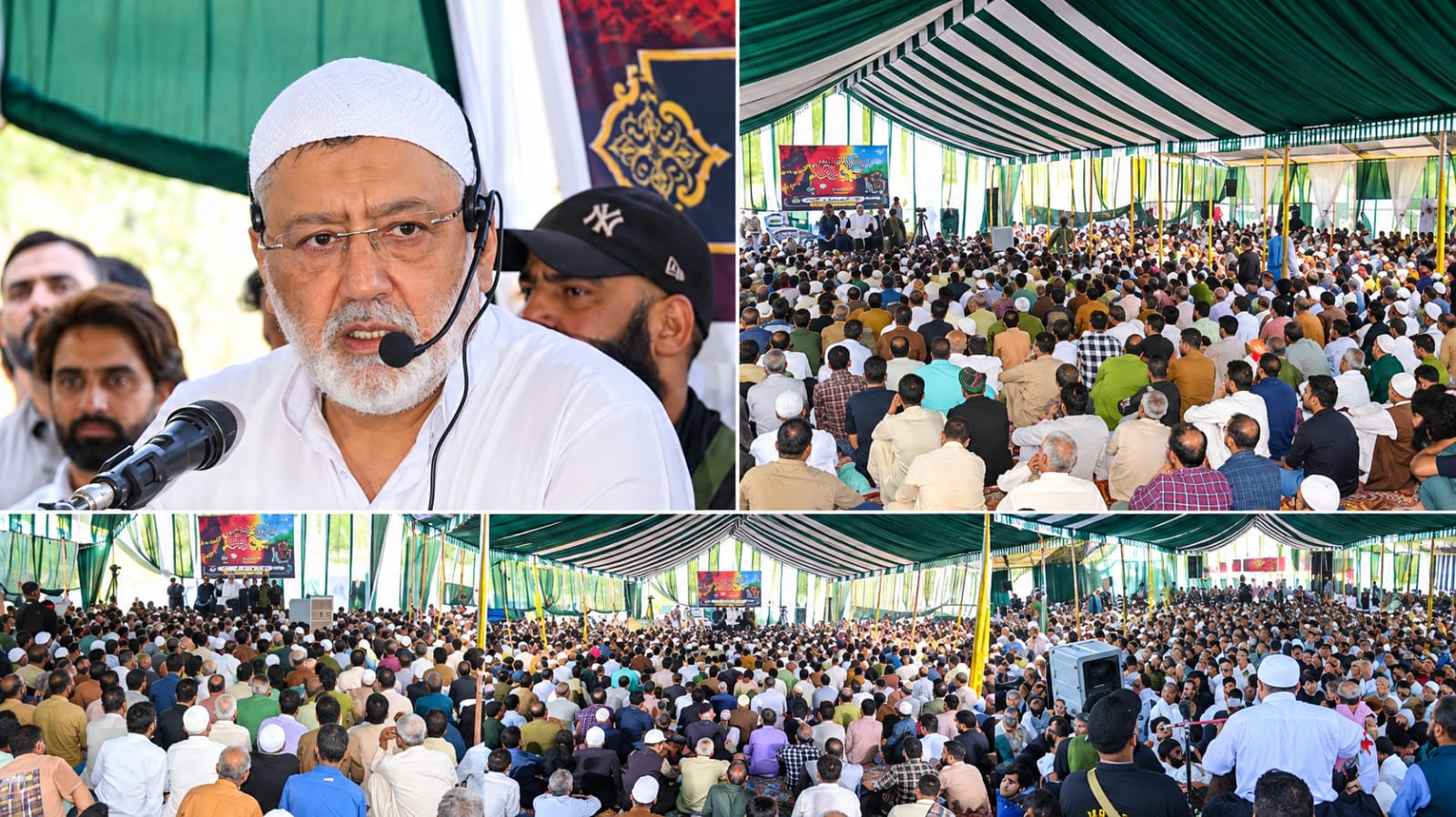
Srinagar, September 6: A Majlis-e-Aza was organised by the All Jammu and Kashmir Shia Association at Balhama in Srinagar, which was attended by a large number of mourners of Imam Hussain (AS) and members of the public. The religious programme commenced at 9:00 am with the recitation of Marsiya, followed by the Majlis-e-Aza.
At around 4:00 pm, President of the All Jammu and Kashmir Shia Association, Imran Raza Ansari, addressed the gathering and spoke at length about the blessed life, teachings and character of Hazrat Imam Ali (AS). He described justice, knowledge, humanity, morality and good character as prominent aspects of Imam Ali’s life and urged Muslims to incorporate these teachings into their practical lives.


During his address, Ansari also highlighted various social issues confronting Muslim society in Kashmir. He said that being a Muslim should not be limited merely to religious identity but should be reflected through a person’s character, conduct and actions.
“Our character should be such that people recognise Muslims as examples of honesty, morality and good behaviour,” he said.
Highlighting the purpose of religious gatherings, he said that after attending a Majlis, every individual should ask themselves what they have learned and whether they are implementing those teachings in their daily lives. The real objective of a Majlis, he said, is to bring about positive change within an individual.
Expressing concern over the growing use of drugs among youth, Ansari said that religious scholars, parents and society as a whole must collectively shoulder the responsibility of combating the menace. He said that when a problem affects a family or a section of society, others cannot remain silent thinking that it does not concern them.
He stressed that the tendency to prioritise individual interests makes meaningful and positive change in the Ummah difficult. He also emphasised the need for unity and mutual cooperation among religious scholars, saying that Ulema can play an important role in social reform and in addressing issues confronting society.
Calling for collective efforts against various social evils, Ansari described such efforts as an urgent need of the hour.
Referring to the increasing misuse of mobile phones and modern means of communication, Ansari said that electronic devices can serve as effective tools for education and acquiring information, but their misuse is adversely affecting the younger generation, the family system and social relationships.
He observed that family members often sit together in the same place while remaining absorbed in their individual electronic devices, resulting in reduced communication and weakening family bonds.
He stressed the need to restore social interaction and strengthen family relationships, saying that positive change must begin with the individual and their own family. From there, he said, the change can extend to neighbours, communities, cities and ultimately the entire country.
Urging people to draw lessons from the tragedy of Karbala, Ansari said that Hazrat Imam Hussain (AS) made immense sacrifices for the triumph of truth and never bowed before falsehood. He paid tribute to the sacrifices and steadfastness of those who gave their lives for the protection and elevation of Islam.
Ansari also referred to the struggle and sacrifices of Ayatollah Sayyed Ali Hosseini Khamenei, stating that his leadership and determination have played an important role in maintaining unity and steadfastness among the Iranian people during difficult circumstances.
On the occasion, special prayers were offered for the forgiveness and spiritual reward of the deceased, including the martyrs of Iran and those affected by the incident at the seminary in Manab.
The Majlis-e-Aza concluded with special prayers for peace, unity, moral reform, social betterment, and the progress and prosperity of the Muslim Ummah.