

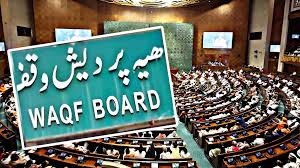
New Delhi: A three-judge bench of the Supreme Court, headed by Chief Justice of India Sanjiv Khanna and comprising Justices Sanjay Kumar and KV Viswanathan, is currently hearing over 73 petitions challenging the constitutional validity of the Waqf (Amendment) Act, 2025.
Senior Advocates Kapil Sibal, Rajeev Dhavan, AM Singhvi, and CU Singh are arguing on behalf of the petitioners, while Solicitor General Tushar Mehta is representing the Union of India.


Opening the arguments, Senior Advocate Kapil Sibal contended that the Waqf Amendment Act interferes with the essential and integral aspects of the Muslim faith, invoking Articles 25 and 26 of the Constitution.
He submitted that the phrase “in accordance with law” in the amended provisions undermines essential religious practices and opens the door for legislative overreach.
The court directed that challenges be presented point by point.
Sibal began by contesting Section 3(r) proviso: ‘It allows Waqf by user to remain unless in dispute or claimed by the government’, which he argued dilutes the essence of Waqf.
Section 3A(2): This provision, which deals with Waqf-alal-aulad and inheritance to women, was questioned by Sibal —”Who is the State to interfere in Islamic inheritance that takes effect only after death?”
CJI responded, noting similar laws exist for Hindu communities, and Article 26 is secular and applies to all religions.
Sibal also challenged Section 3C: Declares government-identified properties will no longer be deemed Waqf after the Act comes into force.
Section 3C(2): Allows government to unilaterally declare such properties without a defined timeline, which he claimed is unconstitutional.
Provision on protected monuments: He argued that Waqf properties should not be invalidated merely because they are later declared ancient monuments.
To this, the CJI observed that Waqf status would remain intact if declared before the monument status.
Further, Sibal targeted Section 3E, arguing that the Act improperly lists Muslims as Scheduled Tribes in an administrative context and criticised the Central Waqf Council’s composition.
He compared it with Hindu and Sikh endowments, saying all nominees in their respective councils are from their own faiths.
Justice Viswanathan interjected, saying religious rights should not be mixed with property issues, “Properties can be secular; only the administration may have religious dimensions.”
Sibal continued by arguing that Section 9 allegedly restricts Muslim membership disproportionately.
Section 14 is seen as allowing complete takeover of Waqf Boards through nomination.
Section 36, allowing Waqf by user without formal registration, was defended.
Singhvi added, “Four out of eight lakh Waqf properties exist purely by user. This amendment wipes them out in one stroke.”
The CJI acknowledged the sensitivity, remarking, “We’re told even Delhi HC may be on Waqf land. We aren’t saying user-based Waqf is invalid, but concerns are genuine.”
Singhvi referred to the Ayodhya verdict, noting that Waqf by user was recognised historically, and questioned whether Parliament could now delete its foundational basis under Section 2(r)(i).
Arguments remain underway. The hearing continues.
UNI