

Goa, Nov 26 (JKNS): Hidden beneath the surface of the earth, flowing through the pages of ancient scriptures and embedded in India’s civilisational memory, the Saraswati River has remained one of the country’s enduring mysteries.


Seeking to bridge the gap between ancient traditions and modern scientific inquiry, the Hindi documentary The Unseen Holy River, Saraswati, featured in the Indian Panorama category of the 57th International Film Festival of India (IFFI) 2026 today.
The documentary explores the fascinating story of the river and the scientific investigations by Dr. Subash C. Singh surrounding the river’s existence.
The film brings together ancient geographical references, geological observations and scientific investigations to present an intriguing exploration of India’s natural and cultural heritage.
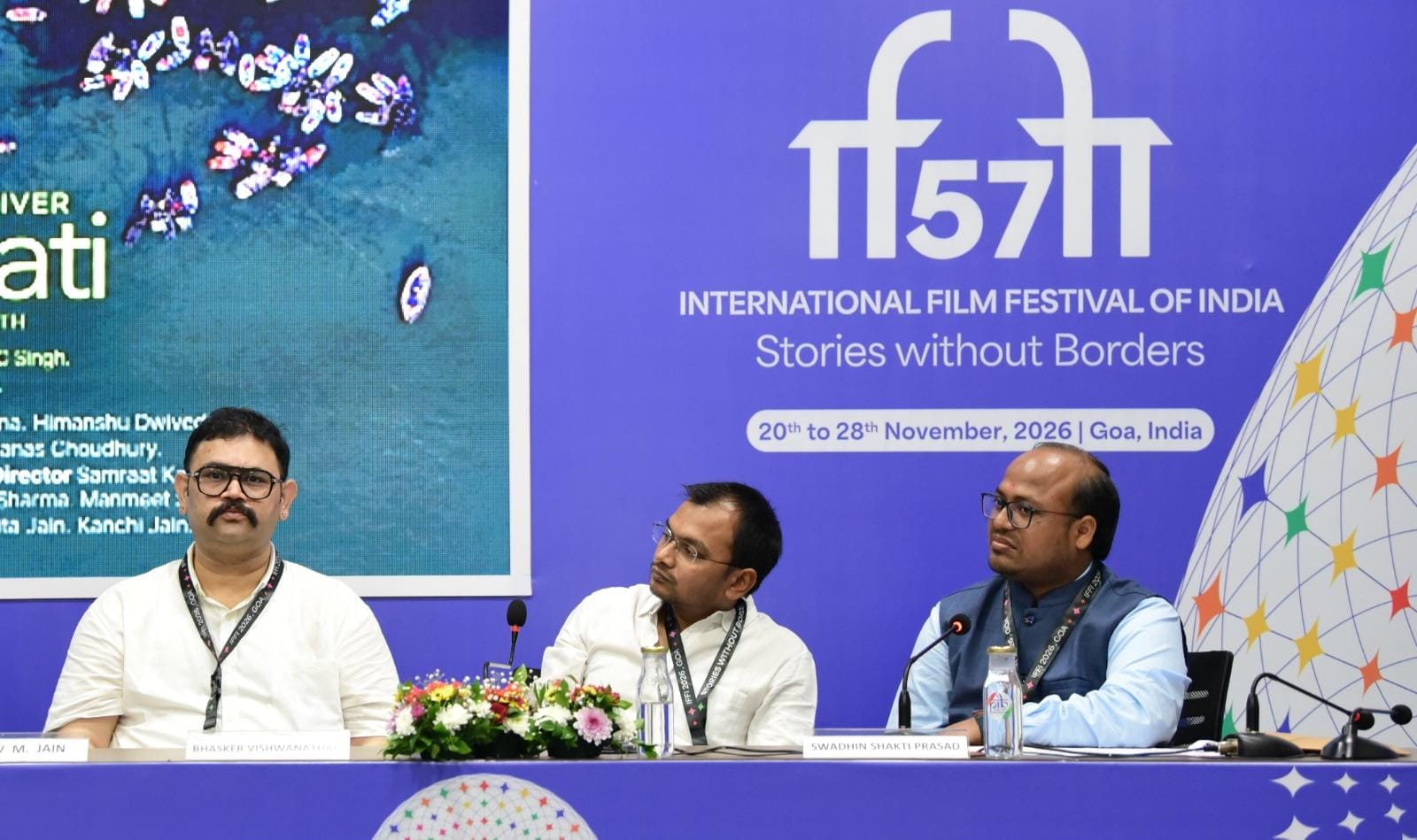
Addressing a Press Conference organised by PIB today, Director Bhasker Vishwanathan shared his experience of making his first documentary and said that the mystery surrounding the Saraswati River was equally fascinating for him, and that the research undertaken on the subject became a major source of inspiration.
He highlighted the historical and cultural significance of the Saraswati, particularly its association with the Saraswat civilisation and the ancient Vedic tradition, with the Vedas believed to have been composed along its banks.
Vishwanathan highlighted that presenting an extensive body of research in a crisp, engaging and entertaining format was a key challenge and his objective was to make the documentary appealing to a wider audience while retaining its research-oriented foundation.
Producer Abhinav M Jain shared that his motivation to produce the film stemmed from his curiosity about India’s rivers and their historical significance. Recalling his visit to the Kumbh Mela at Prayagraj, he said that he observed only the Ganga and Yamuna at the Triveni Sangam which prompted him to explore the third river, Saraswati that finds repeated references in the Vedas and other Hindu scriptures.
Highlighting the scientific dimension of the research, Jain referred to isotopic studies conducted by the National Institute of Hydrology, Roorkee, which examined water samples and contributed to the research surrounding the underground water network.
By bringing together geological research, ancient traditions and contemporary filmmaking, the documentary, The Unseen Holy River, Saraswati, offers audiences an opportunity to revisit a significant part of India’s civilisational heritage through a scientific lens. (JKNS)