

AR Bhat


A land often described as harsh and empty turns out to be one of the richest cultural treasures of South Asia. Ask most people what comes to mind when they hear the word Balochistan, and you will probably get a short answer: deserts, mountains and distance. It is true that the land is vast and dry, stretching across southwestern Pakistan and extending into Iran and Afghanistan. However, anyone who has spent even a little time with its people knows that this quiet landscape is anything but full of stories, songs, stitches and customs that have survived for thousands of years, often against the odds.
Long before the pyramids of Egypt were built, people were farming at Mehrgarh, near the Bolan Pass. Excavations there have revealed a settlement dating back to around 7000 BCE, making it one of the earliest known farming villages in South Asia. The people of Mehrgarh grew wheat and barley, herded cattle, sheep and goats, made pottery and, remarkably, even practised a primitive form of dentistry.
It is a humbling thought that the foundations of what later became the Indus Valley Civilisation were being laid in the very region that the modern world often overlooks. Sites such as Nausharo and Nindowari add further chapters to this story, showing that Balochistan was never on the edge of history. For a long time, it was right at the centre of it.
Today, Balochistan is home to several communities. The Baloch are the largest group, but the Brahui, Pashtuns, Hazaras and others also call it home. Language tells a fascinating story here. Balochi belongs to the Iranian family of languages, while Brahui is a Dravidian language related to languages spoken more than a thousand miles away in southern India. How Brahui ended up in these mountains is still debated by scholars.
If there is one value that defines Baloch culture, it is hospitality. A traveller who knocks on the door of a house in a Baloch village is rarely turned away. The best food is served, the softest bedding is laid out, and the guest is treated with an honour that can surprise outsiders. Hosting a guest well is a matter of personal and family pride.
Closely tied to this is the tradition of ‘hal’, the exchange of news when people meet. Before anything else is discussed, visitors and hosts share updates about their families, journeys and happenings along the way. Even today, this tradition reflects a culture that values people over hurry.
The Baloch code of conduct also places great importance on honour, loyalty and protection. Offering refuge to someone who seeks it, even at personal risk, has long been regarded as a sacred duty.Balochi embroidery is one of the most beautiful crafts of the region, and it is almost entirely the work of women. Their long dresses are covered in fine geometric patterns, stitched in bright reds, greens, oranges and golds, often with tiny mirrors incorporated into the designs. A large embroidered pocket at the front of the dress is one of its most recognisable features.
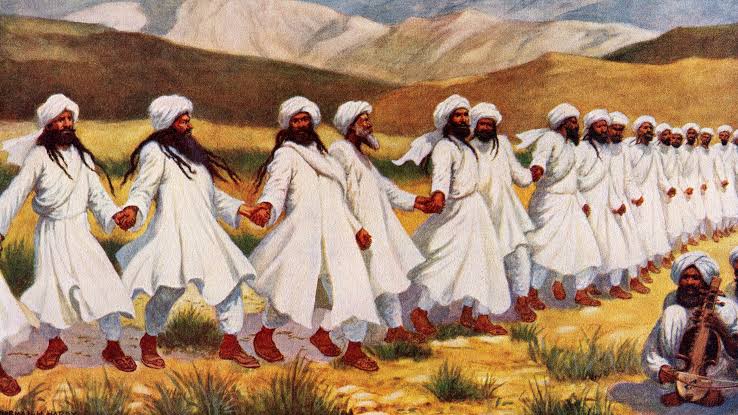
A single dress can take months to finish. Patterns are passed down from mothers to daughters, and a trained eye can often tell which area a piece comes from simply by looking at the stitching. Men traditionally wear a long shirt with very wide, loose trousers, topped with a large turban.Balochi music has a haunting quality that stays with you. The suroz, a bowed string instrument, produces a deep, almost human sound and is often accompanied by the dambura and drums.Dance is a joyful part of celebrations. The Chaap, performed in a circle with rhythmic clapping and turning steps, is a common sight at weddings. The Lewa, with its strong drumbeat, is especially popular along the Makran coast, where African and Arabian influences can be felt in the music.
Poetry, however, may be the true soul of Baloch culture. For centuries, history was preserved not in books but in verse. Epic tales of Mir Chakar Rind, the legendary leader, and romantic stories such as that of Hani and Shay Mureed have been sung by bards from one generation to the next. The classical poet Jam Durrak is still quoted with affection.
No article about Balochistan would be complete without mentioning sajji. A whole leg of lamb or an entire chicken is lightly salted and slow-roasted on skewers over an open fire until the meat becomes tender and smoky. It is simple food, but it is unforgettable. Another favourite is kaak, a hard bread baked around a heated stone. It can last for days, making it perfect for shepherds and travellers undertaking long journeys.
Balochistan’s heritage also includes places that carry deep spiritual and historical significance. The Hinglaj Mata temple, tucked into a cave in the Hingol area, is one of the most important Hindu pilgrimage sites in the region, and thousands of devotees make the journey there every year.The old forts of the region, such as Miri Fort in Turbat, and the heritage of the Khanate of Kalat tell stories of rulers, trade routes and resistance. Meanwhile, the Quaid-e-Azam Residency in Ziarat, surrounded by ancient juniper forests, connects the province to the story of modern Pakistan.
Like many traditional cultures, Balochistan’s heritage faces real challenges. Modern life, migration to cities and economic pressures mean that fewer young people are learning traditional embroidery and music.Yet there are hopeful signs. Every year on 2nd March, Baloch Culture Day is celebrated with enthusiasm. People dress in traditional clothes, perform the Chaap, recite poetry and fill the streets with music. It is a reminder that identity is not only inherited; it is also chosen and celebrated.
Balochistan is often described in terms of what it lacks. However, when you look closely, you find a land rich in memory and meaning. From the first farmers of Mehrgarh to the embroiderers stitching patterns by lamplight today, its people have kept their stories alive. The mountains may be silent, but the culture they shelter has plenty to say, if only we are willing to listen.