

Arshid Rasool


In August 1947, British rule in the subcontinent came to an end and two independent dominions, India and Pakistan, were created. At that time, there were more than 560 princely states which were given the option to accede to either dominion or remain independent. Jammu and Kashmir was one of the largest and most strategically located princely states. It was ruled by Maharaja Hari Singh, a Hindu ruler presiding over a predominantly Muslim population. Initially, Maharaja Hari Singh aspired to maintain the independent status of his state. To ensure continuity of essential services such as trade, communications and transport, he proposed a Standstill Agreement to both India and Pakistan.
The situation changed dramatically in the last week of October 1947. Armed tribal lashkars from the North-West Frontier Province of Pakistan, supported by elements of the Pakistan Army, invaded the state. Advancing along the Jhelum Valley Road, they captured Muzaffarabad, Domel and Uri and moved rapidly towards Baramulla and Srinagar. The invading forces indulged in large-scale looting, arson and violence against civilians. The state forces, stretched and outnumbered, were unable to halt their advance.
Confronted with an existential threat to his state and its capital, Maharaja Hari Singh sought immediate military assistance from India. The Government of India made it clear that troops could be deployed only after the state had legally acceded to the Dominion of India.
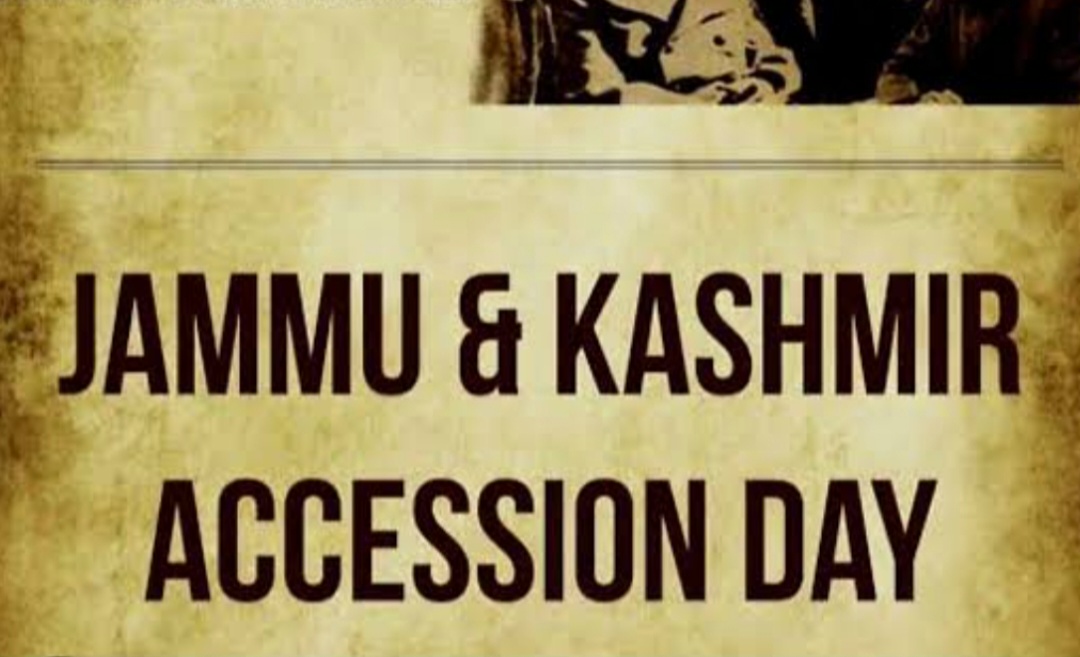
Accordingly, on 26 October 1947, Maharaja Hari Singh executed the Instrument of Accession. The Instrument was in the standard form prescribed for all princely states, providing for accession on three subjects only – Defence, External Affairs and Communications. On the following day, 27 October 1947, Lord Mountbatten, the Governor-General of India, formally accepted the Instrument. On the same morning, Indian troops of the 1st Battalion, Sikh Regiment, were airlifted to Srinagar to secure the airfield and defend the Valley.
The original Instrument of Accession is preserved in the National Archives of India, New Delhi. It has been examined by scholars and compared with similar instruments executed by other rulers, including those of Mysore, Manipur, Baroda and Udaipur. The document bears the characteristics of a 1947 record – the paper is aged and faded. Lord Mountbatten’s acceptance is recorded in green ink, a practice followed by him for other instruments as well. A Standstill Agreement is appended, bearing the signature of the Maharaja himself, as his Prime Minister Mehr Chand Mahajan was then in New Delhi for consultations.
Questions have occasionally been raised about the authenticity and dating of the Instrument. The archival record, however, is clear. The Instrument was placed before the Constituent Assembly of India in November 1947 along with instruments of over a hundred other states. Its text conforms to the common template. Minor handwritten corrections, such as overwriting “August” with “October”, are explained by the fact that most accessions took place in August, whereas Jammu and Kashmir acceded later under extraordinary circumstances.
The accession had immediate consequences. It provided the legal basis for Indian military intervention, which checked the tribal advance on the outskirts of Srinagar. It was followed by the first Indo-Pak war, which ended with a ceasefire and the establishment of the Cease Fire Line in 1949, leaving a portion of the erstwhile princely state under Pakistani administration.
In subsequent years, constitutional provisions such as Article 370 were introduced to define the nature of the relationship between the state and the Union. These provisions were modified in 2019. However, the Instrument of Accession of 26 October 1947 remains the foundational legal document that formally linked the princely state of Jammu and Kashmir with the Dominion of India and forms a crucial chapter in the history of modern India.
At present, Jammu and Kashmir is witnessing a period of peace, progress and prosperity following the abrogation of Article 370 in August 2019. With full constitutional integration, the Union Territory has seen record tourism, massive infrastructure development, restoration of grassroots democracy and new avenues for youth employment and investment.
In stark contrast, the people in Pakistan-Occupied Jammu and Kashmir (PoJK) – an area illegally occupied by Pakistan – continue to suffer severe deprivation. Facing lack of basic rights, economic neglect, political suppression and human rights violations, they are increasingly raising their voice against Islamabad’s discriminatory policies and demanding freedom and justice.