


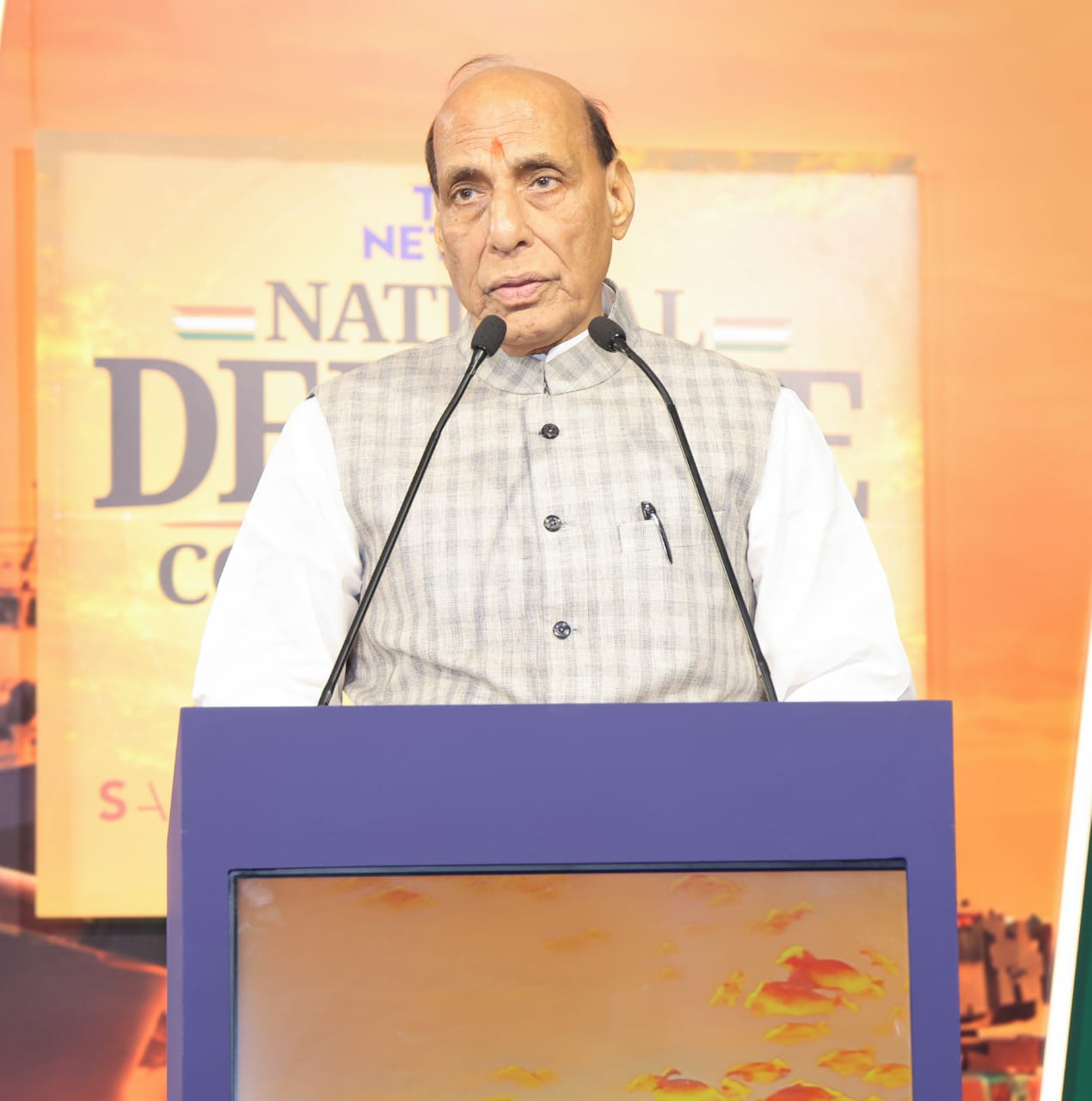
New Delhi, Oct 15 (JKNS): Defence Minister Rajnath Singh on Thursday asserted that India would deliver an even stronger response to any future terror attack originating from Pakistan, declaring that the country’s commitment to peace must never be mistaken for weakness. Citing Operation Sindoor, the Balakot airstrikes and surgical strikes, he said India had shifted from diplomatic condemnation to proactive action against terrorism at its source.


“Operation Sindoor, Balakot Airstrikes and Surgical Strikes weren’t just military operations; they symbolised a decisive shift in the nation’s approach, moving from diplomatic condemnation to proactive action aimed at rooting out terrorism by reaching its very source,” as per news agency JKNS, Raksha Mantri Rajnath Singh said at a Defence Conclave in New Delhi on October 15, 2026.
Reiterating India’s stand on cross-border terrorism, he asserted that any further terrorist acts originating from Pakistan would invite an even stronger response. He emphasised that while India’s cultural ethos favoured dialogue, coexistence and peaceful resolution of disputes, its commitment to peace should not be mistaken for weakness.
He added that since 2014, the ‘shelf life’ of most terrorists had fallen to less than a year, with security forces neutralising them within a year of their taking up arms against India.
Raksha Mantri termed strength and capability as essential to maintaining peace, and underlined that India hopes for peace, but remains prepared for war that sometimes becomes necessary to protect the nation.
“Our commitment to peace remains steadfast, yet we are fully prepared to confront any challenge. Our goal is to build an India that, while advocating for peace, remains vigilant when it comes to security and is fully capable of safeguarding its sovereignty, integrity, and national interests,” he said.
On the evolving security landscape, Rajnath Singh underscored the need for heightened vigilance and preparedness in an era of hybrid, high-tech and hyper warfare. He highlighted the growing complexity of security threats in the digital age, identifying what he described as the ‘5D Security Threat’, Disinformation, Destabilisation, Disruption, Deception and Destruction.
He pointed out that terrorism was evolving beyond organised groups, and emerging threats include ‘lone-wolf’ attacks and ‘white-collar terrorism’, which make it increasingly difficult for security agencies to identify radicalised individuals and prevent potential attacks.
Raksha Mantri referred to the recent incident involving a co-pilot who allegedly attempted to crash a passenger aircraft and Captain Smit Machhar, who risked his life to avert a major terror attack.
“The incident underscored the threat posed by lone-wolf attackers while demonstrating how the courage and commitment of an individual could thwart the designs of those driven by hatred. A single alert and courageous individual could help foil an entire terrorist plot. The fight against terrorism requires not only the capabilities of security agencies but also the active participation of aware and responsible citizens,” he said.
On defence preparedness, Rajnath Singh underscored the need to combine ‘hard power’ with ‘soft power’ and called for a shift towards ‘smart power’. “Modern defence strategies must integrate precision-guided weapons and loitering munitions with cost-effective weaponry, human intelligence with artificial intelligence, and advanced systems with low-cost, agile and adaptable technologies to address evolving security challenges,” he said.
Raksha Mantri attributed India’s growing confidence in its defence capabilities to reforms, changes in operational methods and a transformed mindset under the leadership of Prime Minister Narendra Modi. He stated that in the last twelve-and-a-half years, the Government has shifted its focus from meeting immediate defence requirements to building an Aatmanirbhar and future-ready defence ecosystem. He highlighted that reforms in licensing regulations and measures to improve ease of doing business helped expand the country’s defence manufacturing base, with more than 500 companies now engaged in the sector and hundreds of new industrial licences issued.
On the reforms in defence procurement, Rajnath Singh said priority is being given to domestic industries for the modernisation of the defence forces through measures such as the Defence Acquisition Procedure and the ‘Buy Indian-Indigenously Designed, Developed and Manufactured’ category. He noted that 75 per cent of the modernisation budget has been earmarked for procurement from Indian industries, adding that the reforms had strengthened collaboration between the public and private sectors. The nation is shifting from a ‘Whole of Government Approach’ to a ‘Whole of Country Approach’ and, gradually, to a ‘Whole of the People Approach’, with start-ups, MSMEs, individual innovators and large corporations contributing to national defence under the spirit of ‘Nation First’, he said.
Raksha Mantri described Operation Sindoor as a demonstration of India’s growing technological capabilities and the defence forces’ confidence in advanced indigenous systems, including the Akash missile system and BrahMos, alongside other cutting-edge equipment. He said the success of the operation reflected the growing confidence in India’s domestic defence industry and its contribution to national security. “The defence forces had issued five positive indigenisation lists covering 509 items, including defence equipment, weapon systems and platforms, with a sixth list prepared for release soon. Similarly, Defence Public Sector Undertakings (DPSUs) had identified 5,012 items for indigenisation, including Line Replacement Units, sub-systems, spares and components, of which 3,255 had been indigenised,” he said.
On the growth witnessed by the defence sector due to the Government’s efforts, Rajnath Singh stated that defence production has risen to a record over Rs 1.78 lakh crore from Rs 40,000 crore in 2014, with defence exports touching an all-time high of Rs 39,000 crore from Rs 686 crore in 2013-14, and Indian defence products reaching nearly 100 countries. He exuded confidence that the nation would achieve defence production targets of Rs 2 lakh crore this year and Rs 3 lakh crore by 2029, and export defence equipment worth Rs 50,000 crore by 2029.
Raksha Mantri attributed the growth to reforms that simplified export procedures, including the introduction of the Defence EXIM Portal, online approvals, the Open General Export License, streamlined quality certification and the ‘Green Channel’ policy. These measures, he said, enhanced India’s global credibility and prepared domestic industries to compete in international markets.
Emphasising the importance of research, development and innovation in achieving Aatmanirbharta in defence, Rajnath Singh highlighted that the Government has created opportunities for start-ups, MSMEs and young innovators through initiatives such as the iDEX, iDEX Prime and ADITI schemes. “The Ministry of Defence has approved procurement of goods and services worth over Rs 2,400 crore from start-ups and MSMEs and sanctioned projects exceeding Rs 1,500 crore for new technology development. As of March 2026, iDEX had engaged 676 start-ups and innovators and facilitated the signing of 551 contracts. From a few dozen defence start-ups in 2018, the ecosystem had grown to more than 2,000, with young enterprises working across drones, artificial intelligence, quantum technology, cybersecurity, robotics and other advanced fields,” he added.
On the expansion of India’s defence industrial ecosystem, Raksha Mantri said defence production was no longer confined to the public sector, as DPSUs, private industries, more than 16,000 MSMEs, supply units and innovation centres are all contributing to the sector.
“The corporatisation of OFB has helped transform them from loss-making entities into profitable enterprises. The growing network of public and private stakeholders is India’s new defence industrial family,” he said.
Further highlighting the reforms in defence procurement, Rajnath Singh stated that the sector was undergoing modernisation and indigenisation with greater transparency and accountability. Citing progress in ammunition manufacturing, he said 159 of the 175 ammunition variants used by the Defence Forces were now indigenously produced, representing more than 90 per cent self-reliance in ammunition variants. Referring to India’s exports of bulletproof jackets to over 100 countries, he noted that the country was the fourth in the world to establish a national standard for bulletproof jackets aligned with international norms.
He also spoke about the implementation of the One Rank One Pension scheme and the creation of the Chief of Defence Staff post, terming them significant measures undertaken to strengthen the defence framework.
Raksha Mantri concluded the address by expressing confidence that, when India completes 100 years of its independence, it will become ‘Viksit Bharat’ and provide leadership to the world across domains, including technology, the economy and defence. (JKNS)