


Mushtaq Bala


There comes a point when a delay ceases to be administrative and begins to become an injustice.
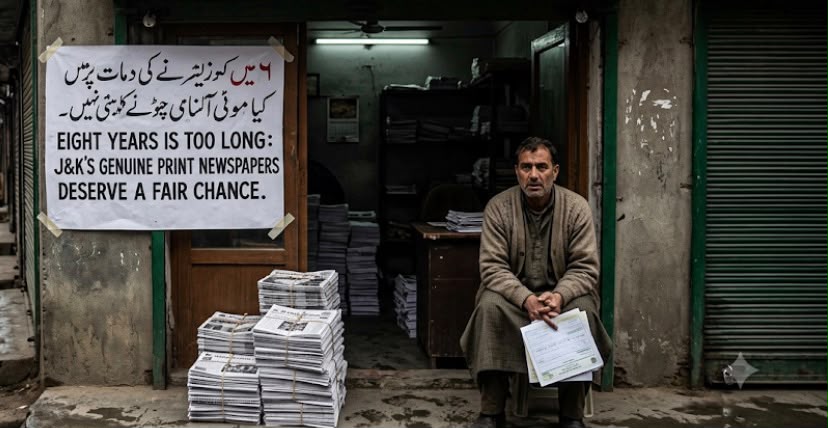
The issue of fresh empanelment of newspapers in Jammu and Kashmir has remained pending for far too long. Several newspapers that have been in regular print for eight to ten years—or even longer—are still waiting for their cases to be considered for empanelment.
These are not publications that appeared yesterday. They have invested years of effort, money and manpower in building their readership and maintaining continuity of publication. Many small publishers have continued printing their newspapers despite severe financial constraints, often meeting expenses from their own pockets simply to ensure that publication does not stop.
Some have quite literally spent their last available resources to keep their publications alive.
Yet, after years of continuous publication, they continue to wait.
Print newspapers and social media are not the same
One issue that requires immediate clarification is the apparent linking of fresh newspaper empanelment with the policy or empanelment of social-media and digital platforms.
The two should not be allowed to become interchangeable.
A registered newspaper with an established record of regular print publication is a fundamentally different media entity from a social-media platform. Print newspapers have identifiable publishers, editors, printers, periodicity and established systems of accountability. They also operate under a regulatory and registration framework applicable to publications.
Social-media platforms constitute an entirely different category of communication.
There may be a legitimate need for the government to formulate appropriate policies for digital and social media. But that process should not become a reason—directly or indirectly—for keeping genuine print newspapers waiting indefinitely.
The two streams need to be administratively segregated.
What are small newspapers asking for?
The demand of these newspapers is not for preferential treatment.
They are asking for a fair, transparent and time-bound process.
If a newspaper has fulfilled the prescribed requirements, has maintained regular publication for several years and is otherwise eligible, its case should be examined on its merits.
The Information Department should consider publishing clear criteria and a definite timeline for processing pending applications. Publishers should also be able to know where their cases stand and what, if anything, remains to be completed.
Such transparency would eliminate uncertainty and also strengthen confidence in the empanelment process.
The financial reality cannot be ignored
For a small newspaper, government advertising is not merely another source of income. It can be crucial to survival.
Printing costs have increased. Salaries and professional expenses have increased. Distribution and infrastructure also require continuous expenditure. Unlike large media organisations, small newspapers often operate with very limited financial reserves.
Despite this, many publishers have continued publication for years without interruption.
They have done so because they believe that local journalism matters.
They believe that a newspaper should remain available to its readers even when the economics of publishing make the task increasingly difficult.
That commitment should not be taken for granted.
A direct appeal to the government
The Jammu and Kashmir Government, particularly the authorities concerned with information and media policy, should look at this issue with urgency.
The administration has every right to prescribe eligibility conditions and ensure that only genuine and compliant publications receive government advertising. But once those conditions are met, an eight- or ten-year wait for empanelment deserves an explanation and, more importantly, a solution.
The Chief Minister and the concerned authorities can play an important role by directing that the pending cases of eligible print newspapers be reviewed independently and expeditiously, without allowing them to be held up by issues concerning digital or social-media platforms.
The question is ultimately one of fairness.
A newspaper that has survived for eight or ten years without empanelment should not have to spend another year merely waiting to be heard.
Jammu and Kashmir needs a diverse and independent media ecosystem in which small and large publications can coexist. Genuine newspapers that have demonstrated continuity, invested their own resources and served readers through difficult years deserve an opportunity to sustain themselves.
The publishers have already waited long enough.
Now, what they need is not another assurance—but a transparent process, a clear decision and a reasonable timeline.