

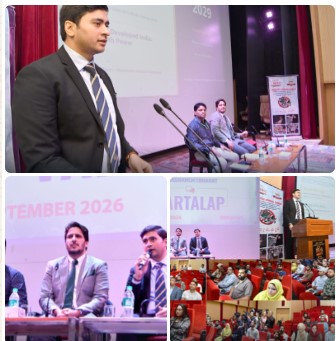
Srinagar, Sep 16 (JKNS): The Press Information Bureau (PIB), Srinagar, in collaboration with the Narcotics Control Bureau (NCB), on Wednesday organised ‘Vartalap’ in Srinagar to create awareness about the Government of India’s Vision Document 2026-2029 for building a drug-free India, with focus on enforcement, prevention, harm reduction and coordinated action against the drug menace.
As per news agency JKNS, PM Modi, GOI, has resolved to make a ‘Drug-free India’ by 2029. To fulfil this resolve, Union Home Minister Amit Shah, had launched Vision Document 2026-2029, for a Nashamukt Bharat in June 2026.

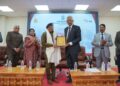
In line with and to create awareness about Vision Document 2026-29, Press Information Bureau (PIB), Srinagar has organised ‘Vartalap’, in collaboration with Narcotics Control Bureau (NCB) in Srinagar today. The ‘Vartalap’ highlighted various aspects and salient points of the Vision Document 2026-2029, to create a ‘Drug-free India.
Prime Minister Narendra Modi has set before the nation the resolve to build a fully developed India by 2047. Bharat will rest not only on a healthy economy, a secure society, modern technology, and strong institutions, but also on a healthy, disciplined, culturally rooted, and drug-free youth force. India is the youngest major nation in the world. Our youth power is India’s greatest strength. Drugs affect health, families, social order, and the security of the nation. Nasha-Mukt Bharat 2029, is a key foundation stone for Viksit Bharat 2047.
Under the leadership of Union Home Minister Amit Shah, the Ministry of Home Affairs (MHA) has taken several key initiatives, including launch of Vision Document, for preventing use of drugs.
The ‘Vartalap’, conducted by Piyush Kumar Ankit, Zonal Director, NCB (Jammu & Kashmir and Ladakh Region), Director Press Information Bureau, Srinagar, Qazi Salman, and Assistant Director (Media), MHA, Rajeev Kumar Rustagi, focussed on an effective strategy to create awareness about Nasha Mukt Bharat Campaign. The mediapersons attending the ‘Vartalap’ were apprised of key achievements against drugs across the country, in terms of drug seizure, arrest, deep-level investigation and destruction of seized drugs.
A three-year roadmap from July 2026 to July 2029 is to create a ‘Drug-free India’, with the resolve to achieve all targets in a time-bound manner. The roadmap is based on four pillars – Intelligence and operation-based enforcement, Precursor and synthetic drugs control, Demand and harm reduction, and Capacity building and coordination. The operational mantra for these four pillars is Detect, Disrupt and Destroy. Detect: Identify the source, route, peddler, technology, payment channels, and kingpins. Disrupt: Target transit, logistics, precursor supply, darknet networks, hawala, and narco-financing. Destroy: Eliminate drug laboratories, illicit cultivation, cartel assets, leadership, and the entire distribution network.
The Government under the leadership of Prime Minister Narendra Modi has made the fight against drugs a national security priority. Destruction of clandestine drug labs, bringing back drug-offenders and fugitives, system integration and achieving measurable national outcomes have been given special focus in the Vision Document.
The Ministry of Education, Youth and Sports, along with educational institutions, are resolving to make educational institutions drug-free. Through NCC, NSS and My Bharat, lakhs of ‘Nasha Mukt Bharat Mitras’ will be prepared.
The presentation also highlighted the roadmap for the creation of Nasha Mukt Bharat, through, Supply Reduction, Demand Reduction and Harm Reduction. It also highlighted targeting networks, finance and fugitives, to curb the menace, with a Whole-of-Government approach. Strengthening joint striking capability of agencies, from policy to prosecution, has also been given priority in the Vision Document.
The Vision Document has been prepared with in-depth consultations with concerned Central Government Ministries, Departments, drug law enforcement agencies and other stakeholders, providing a shared roadmap to address the demand-reduction, supply-reduction and harm-reduction aspects of the drug menace.
The roadmap envisages a network-centric enforcement approach and outlines measures to address challenges related to synthetic drugs and darknet-enabled trafficking, prevent drug abuse among youth, expand access to treatment and rehabilitation centres, and strengthen coordinated action over the next three years.
The ‘Vartalap’ also sought public participation and creation of awareness in society through the media, as an effective information medium. (JKNS)