


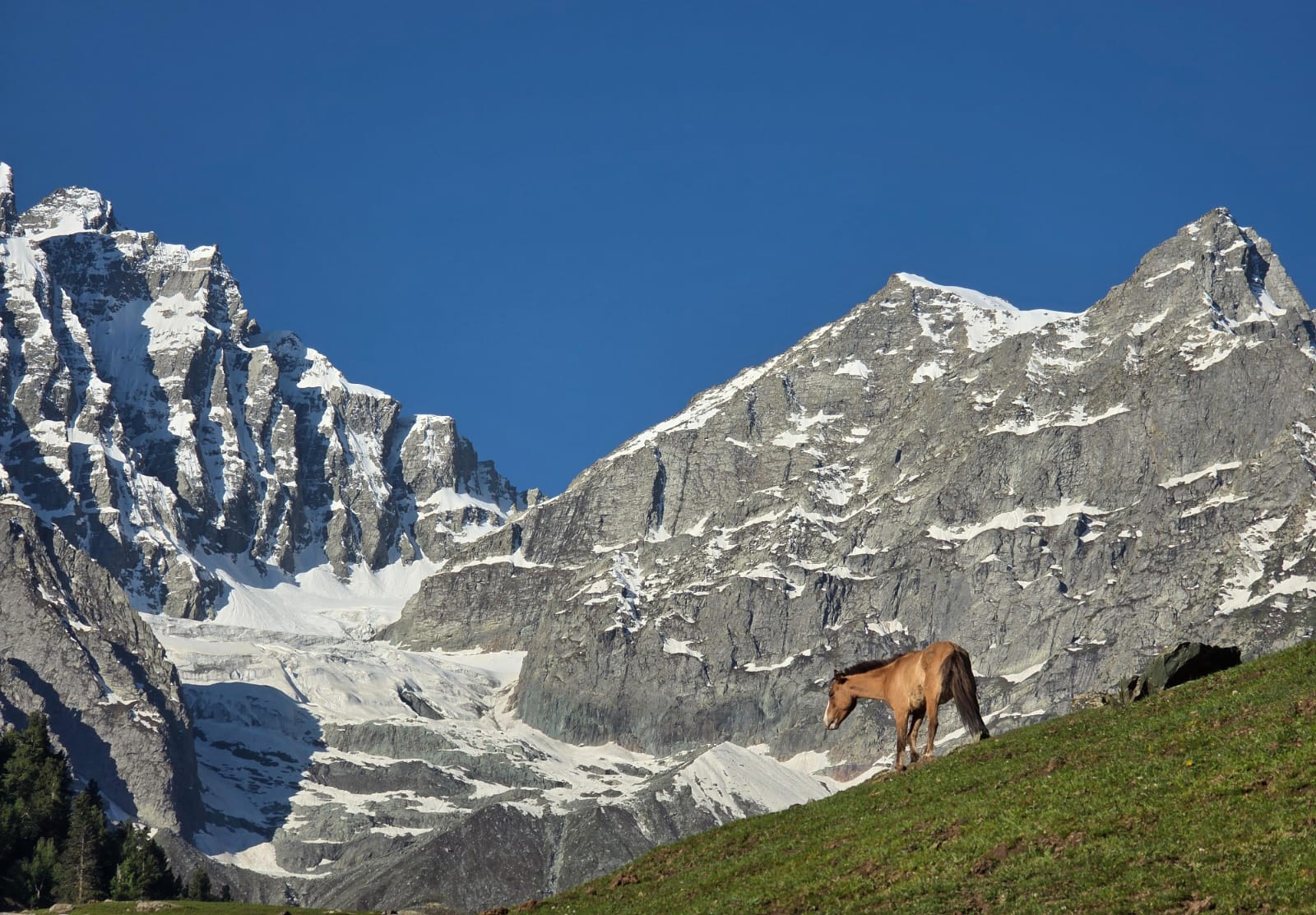
“A single act of violence cannot erase a thousand years of welcome. But it can, if the response is inadequate, interrupt the fragile confidence on which tourism always depends.” Violence, when it strikes a tourist destination, does not merely wound those directly in its path. It sends a tremor through every layer of the economy that tourism sustains the hotel at the end of the valley road, the shikara family that has worked Dal Lake for four generations and the young guide who spent three years learning languages and mountain routes to earn the right to take visitors into the high passes. The Pahalgam attack of April 2025 was an act of terror in the most precise sense, its target was not only human life but the confidence on which an entire regional economy depends.
The timing was particularly cruel. Kashmir’s tourism sector had been in the midst of its most sustained period of growth in living memory. Visitor arrivals had crossed 21 million in 2024, a figure that would have seemed implausible a decade earlier. Hotels were booked. The spring season, when the valley is at its most breath-taking, the chinar trees newly green, the rivers full, the meadows of Pahalgam itself carpeted in wildflowers, was about to begin in earnest. In a matter of hours, that momentum was suspended. Understanding the full impact of what followed and the adequacy of the responses it prompted requires looking honestly at the numbers, the human stories behind them and the structural questions the attack has placed on the table for policymakers, business owners and the valley’s communities.
The cascade of cancellations that followed the attack was swift and, in some segments of the market, near total. Tour operators across the country reported cancellation rates of between sixty and eighty per cent for April and May bookings within the first week. Airlines reduced frequencies on Srinagar routes. Adventure tourism operators who had pre-positioned equipment and staff for the spring trekking season found themselves in suspension, bearing costs with no revenue to offset them. The mathematics of such an interruption are particularly unforgiving in Kashmir because of the seasonal structure of its tourism economy. The April to October window generates the overwhelming majority of annual tourism revenue. A disruption of even six to eight weeks at the season’s opening does not merely reduce annual income proportionally, it can eliminate profitability entirely for businesses operating on thin margins and carrying the costs of year-round staff and loan repayments.
Estimates from industry bodies suggested that daily revenue losses in the immediate aftermath ran to several crore rupees across the hospitality, transport and handicraft sectors. For the approximately 1.5 million livelihoods directly or indirectly dependent on tourism, the interruption represented not an inconvenience but a genuine crisis of household income. Houseboat families on Dal Lake, many of whom carry debt from refurbishment investments made during the boom years, found themselves with empty vessels and no clear timeline for recovery. Statistics, however rigorously compiled, do not capture the texture of what an economic shock of this kind means for the communities it touches. A moratorium on loan repayments, announced by the government in the weeks following the attack, is a meaningful intervention. But it does not replace the income a houseboat family needs to buy food, keep children in school or maintain the vessel. It defers a problem, it does not dissolve it.
The craftspeople of Srinagar’s old city were among the most acutely affected. Kashmir’s handicraft tradition, its pashmina weaving, its papier-mache, its hand-knotted carpets that can take years to complete, is almost entirely dependent on tourist footfall and the export orders that tourist exposure generates. A season without visitors is not merely a season without sales. It is a season in which the knowledge base for these crafts, already under pressure from cheap imitation goods and an ageing master craftsperson population, loses another year of transmission to the next generation. For young Kashmiris who had built livelihoods as guides, drivers and hospitality workers, many of them first-generation entrants into the formal economy, the disruption carried an additional dimension of psychological weight. A generation that had chosen to invest in tourism as a pathway to stable income needed to see that the system would hold, that the institutions supporting it would respond with urgency and competence. The quality of the institutional response, in this sense, was as important as its speed.
The government’s response operated on several tracks simultaneously with varying degrees of effectiveness. The loan moratorium was the most immediately tangible measure. The deployment of additional security personnel to tourist areas and the reestablishment of visible safety infrastructure in Pahalgam and other destinations addressed the most pressing concern of prospective visitors, not simply whether they were welcome but whether they would be safe. The Jammu and Kashmir Tourism Department moved with reasonable speed to launch what it called a ‘solidarity campaign’, a combination of discounted packages for domestic visitors, intensified outreach to travel agents in major source markets and the activation of official social media channels to communicate that the valley remained open and that the warmth of its welcome was undiminished.
The campaign was competent, though critics noted that its reach within the travel trade was narrower than the scale of the challenge required. The BCCI’s decision to relocate the IPL matches that had been scheduled in the region was a significant blow to the recovery narrative. Whatever the operational justifications, the symbolic message of a major sporting body withdrawing from Kashmir at precisely the moment when the Valley needed visible affirmations of normalcy was difficult to absorb. It underscored a recurring challenge for Kashmir’s tourism authorities, the destination’s image is shaped by decisions made by entities far beyond their control.
Civil society, by contrast, moved with impressive speed and authenticity. Local tour operators, hotel owners and community leaders began producing and sharing video content from their own channels within days of the attack, showing an occupied Dal Lake, a functioning Gulmarg and an old Srinagar city going about its daily life. This grassroots communication, reaching existing guest networks and travel communities online, was in many respects more effective than official messaging because it carried the weight of personal testimony rather than institutional reassurance.
Beyond the immediate crisis, the Pahalgam attack has performed a diagnostic function that policymakers would be unwise to ignore. It has revealed with uncomfortable clarity, the structural vulnerabilities that have been present in Kashmir’s tourism economy for years and that a period of rapid growth had temporarily obscured. The first vulnerability is geographic concentration. The vast majority of Kashmir’s tourism activity is clustered in a handful of destinations, Srinagar, Gulmarg, Pahalgam and Sonamarg. This concentration means that a single incident in one location, however localised in its actual impact, casts a shadow over the entire destination. A more distributed tourism geography with visitor activity spread across the valley’s many lesser-known areas, would be materially more resilient to precisely this kind of shock.
The second vulnerability is seasonal compression. An economy that generates the majority of its annual revenue in a six-month window has an inherent fragility that diversification of the tourism product, winter sports, wellness, literary and cultural tourism and adventure activities timed to different seasons could substantially reduce. The attack struck at the opening of the high season precisely because that is when tourism is most concentrated. A genuinely year-round visitor economy would distribute risk across the calendar.
The third vulnerability is the thinness of the financial buffers available to most tourism sector businesses. The rapid growth of recent years has been financed, in many cases, by debt loans for houseboat refurbishment, hotel expansion and vehicle purchase for the transport sector. Businesses operating close to their debt service capacity have almost no capacity to absorb a revenue shock of this magnitude without intervention. A tourism resilience fund, a state-managed instrument that tourism businesses contribute to in good years and draw on in crisis years, would represent a structural improvement on the current model of ad hoc government support.
The international evidence on tourism recovery from security incidents is, taken as a whole, genuinely encouraging. Destinations that have experienced terrorist attacks, such as Bali, Istanbul, Paris and Sharm el-Sheikh, have, with very few exceptions, returned to and eventually surpassed pre-incident visitor numbers. The variables that determine how quickly recovery occurs are well understood: the speed and credibility of the security response, the quality of communication with the travel trade and with prospective visitors, the degree to which the destination’s own communities lead the recovery narrative and the presence or absence of pre-existing structural strengths.
Kashmir has significant structural strengths. Its natural environment is, by any objective measure, among the most spectacular in Asia. Its cultural heritage, the Mughal gardens, the Sufi shrines, the living craft traditions, the distinctive cuisine and music, offer a richness that few destinations can match. Its people have a tradition of hospitality so deep that it predates the modern concept of tourism by centuries. These are not marketing slogans. They are genuine competitive advantages that no single incident can erase.
The recovery timetable will be shaped, above all, by two factors, the persistence of the security environment and the quality of the institutional response. If the security situation stabilises and the government’s support measures reach the businesses and workers who need them most, the trajectory of the spring and summer season that follows the initial shock could be meaningfully positive. Domestic tourists who have consistently demonstrated a shorter ‘fear horizon’ than international visitors following security incidents are likely to return.
The most important lesson the Pahalgam attack offers is not about security management as important as it is. It is about the nature of resilience. A resilient tourism economy is not immune to shocks. It is structured so that shocks do not cascade into existential crises. Building that resilience requires, in the first instance, the geographic and seasonal diversification discussed above. The valley’s hidden assets include Lolab, Bangus, Gurez, the Warwan Valley, the ancient temples of the Jammu region and the Buddhist heritage of Ladakh. Borderlands with the Valley need not just promotion but the infrastructure investment that makes them genuinely accessible and hospitable to visitors.
It requires, in the second instance, a serious policy commitment to local ownership and local supply chains. Too much of the value generated by Kashmir’s tourism boom has flowed outward to hotel chains, online booking platforms and tour operators headquartered elsewhere. A policy framework that prioritises local enterprise through preferential access to tourism zone licences, subsidised business development support and procurement rules that favour local suppliers would ensure that the next period of growth translates more directly into improved living standards for Kashmiri households.
And it requires, finally, a sustained investment in communication, not the official communication of government campaigns but the authentic, person-to-person communication of a Valley that knows its own worth and is not prepared to let a single act of violence write the story of what it is. The voices that will ultimately rebuild Kashmir’s reputation as a destination are not those of tourism ministers or marketing agencies. They are the voices of the houseboat owner on Dal Lake, the weaver in the old city, the young guide leading a trek through the high passes and the millions of visitors who have returned from Kashmir carrying, in the words of a traveller who went decades ago, a piece of the place in everything, they do for the rest of their lives.
Kashmir has never been a place that asked for easy circumstances. Its history is one of endurance through conditions that would have diminished lesser places. The Pahalgam attack is a chapter in that history, a painful one but not a final one. What it asks of those who care about the valley’s future is not sentiment but strategy, the strategic diversification of a tourism economy that has grown too fast in too narrow a direction, the strategic investment in the financial resilience of the businesses and workers who sustain it and the strategic commitment to a communication of Kashmir’s identity that is led by Kashmiris and anchored in the truth of what the Valley actually is one of the most beautiful, most historically layered and most genuinely hospitable places on earth. The meadows of Pahalgam will bloom again this spring. The question is not whether Kashmir will recover. It is whether the recovery will be used to build something more durable than what existed before.