

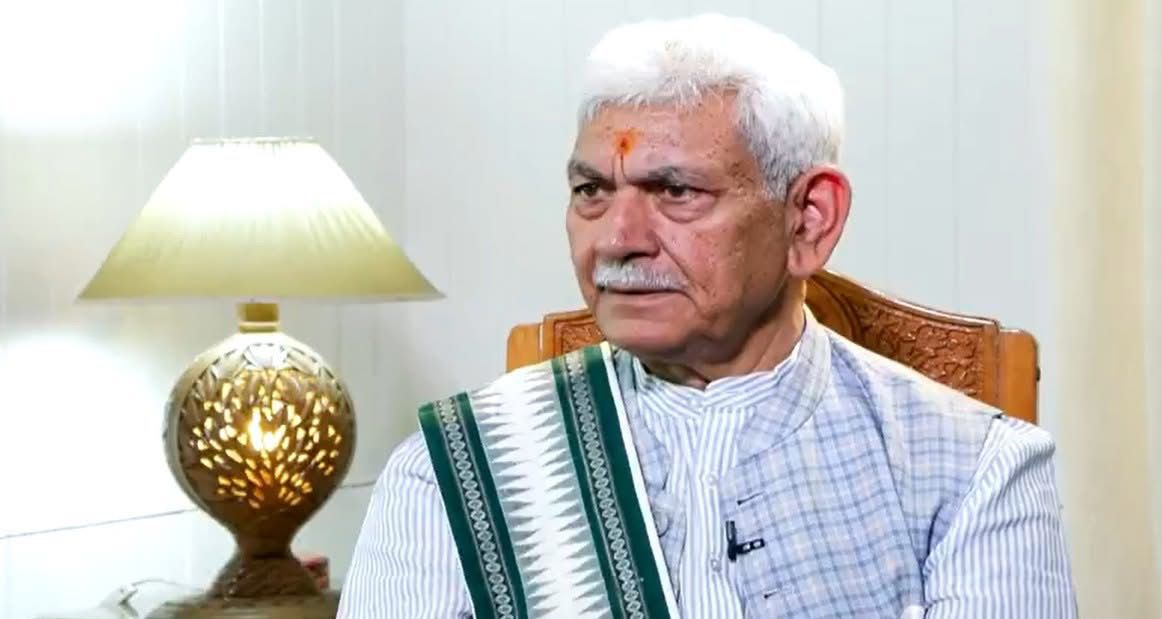
Srinagar, May 17 (JKNS): The Jammu and Kashmir Lieutenant Governor Manoj Sinha on Monday, said that the ongoing anti-narcotics campaign in Jammu and Kashmir has emerged as a strong public movement and is directly aimed at dismantling the drug terror nexus in the Union Territory.
LG Sinha, in an exclusive interview with a national news channel as per news agency JKNS said that “the drive, launched under the “Nasha Mukt Bharat Abhiyan,” has witnessed massive public participation and significant operational success, marking one of the most intensive crackdowns on drug networks in recent years.”


Launch of Narcotics-Free Campaign and Public Response
LG Sinha said that the Narcotics-Free India campaign was launched by the Hon’ble Prime Minister in 2020 and has since created a nationwide impact. He noted that under the guidance of the Union Home Minister, coordinated efforts against narcotics have been continuing for the last five years with a focus on strengthening enforcement mechanisms and improving coordination with states and Union Territories.
He said that in Jammu and Kashmir, the situation had become particularly serious, with rising drug abuse cases and increasing impact on youth. He recalled that reports of drug-related deaths and arrests of young individuals were becoming frequent, which deeply concerned the administration. After discussions with officials and field officers, it was decided that a large-scale public campaign should be launched against drug abuse.
The campaign formally began on 11th April from Jammu and gradually expanded across the Union Territory. The LG said he was surprised by the scale of public participation, noting that in the last several years, no campaign had witnessed such massive involvement from citizens. He described it as a “true public movement” where people from all sections of society, including youth, women, elders, academicians, religious leaders, social activists, and political representatives, came forward together.
Drug-Terror Nexus and Its Impact on Society
Highlighting the seriousness of the issue, Sinha said that drug trafficking and terrorism in Jammu and Kashmir are closely interconnected. He stated that based on investigation reports, it is evident that money generated from narcotics smuggling does not remain limited to personal enrichment but eventually reaches terrorist organisations.
He explained that these funds are used for purchasing weapons, supporting radicalisation activities, and sustaining terrorist networks. According to him, this makes the drug problem not only a social and health issue but also a serious security threat. He warned that the nexus is destroying the younger generation and simultaneously weakening the future of both Jammu and Kashmir and the country as a whole.
He further said that the broader fight against terrorism, being led under the leadership of the Prime Minister, has already achieved significant success, and breaking the drug network is essential to completely eliminate terrorism from the region.
Drug Supply Routes and Cross-Border Involvement
On the question of drug supply routes, the LG said that narcotics are entering Jammu and Kashmir through multiple channels, primarily involving cross-border networks. He stated that neighbouring regions and countries are involved in facilitating this supply chain, whether directly or indirectly.
He specifically mentioned infiltration routes through areas such as Tangdhar, Karnah, Gurez, and also through border districts like Kathua and Samba. He added that parts of Punjab and other connected routes are also being used for smuggling activities. In recent times, he said, drone-based drug drops have also emerged as a new challenge.
He emphasized that the administration is working on a three-front strategy to dismantle the supply chain completely and ensure that every route of infiltration is systematically blocked.
Major Enforcement Action and Crackdown
Providing details of the enforcement drive, Sinha said that the Jammu and Kashmir administration has achieved more than 90 percent success in targeted operations during the recent crackdown period of around 37–38 days.
He stated that 766 FIRs have been registered and 856 individuals have been arrested in connection with drug-related offences. During this period, 677 kilograms of drugs were seized, including heroin and other psychotropic substances. Additionally, nearly 19,400 units of psychotropic substances were recovered.
He also informed that 31 individuals were detained under preventive detention laws such as PIT NDPS and DPS. Property attachment worth ₹52.41 crore involving 117 properties was carried out, while demolition actions affected properties valued at approximately ₹17–18 crore. He clarified that these actions are targeted and based on investigation rather than indiscriminate enforcement.
Sinha also mentioned that 410 driving licences were recommended for cancellation, 188 were cancelled, along with multiple cancellations and recommendations related to registration certificates and passports.
Awareness Campaign and Public Participation
The LG said that alongside enforcement, a massive awareness campaign has been launched across Jammu and Kashmir. Under the Hotspot Focused Awareness Programme, more than 4.52 lakh people have been sensitised about the dangers of drug abuse.
He said that the administration has also taken action against 165 druggists and chemists involved in illegal activities. Awareness drives are being conducted in schools, colleges, religious institutions, and rural areas to ensure maximum outreach.
He added that sports and cultural activities are being actively used as tools to engage youth. Events such as volleyball tournaments have already been organised, and plans are underway to expand football, cultural programmes, and music-based initiatives to channelise young energy in a positive direction.
According to him, the response has been spontaneous, with people voluntarily joining the campaign in large numbers, reflecting a strong social awakening against drug abuse.
Rehabilitation Strategy and Policy Framework
Sinha acknowledged that rehabilitation remains one of the most challenging aspects of the anti-drug strate…