


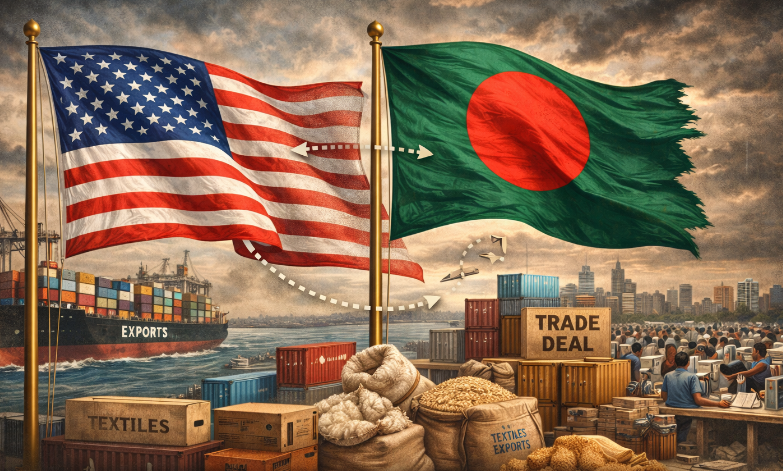
The February 2026 trade agreement between the United States and Bangladesh has been marketed as a pragmatic bargain: a little tariff relief here, a little market access there, and supposedly a stronger bilateral partnership at the end of it. That is the sales pitch. The reality looks far uglier. Read the public text closely, and the agreement appears less like balanced trade diplomacy and more like a structured invitation for U.S. capital to penetrate Bangladesh’s most strategic sectors under terms written to privilege American commercial power. Even Washington barely disguises this.
The U.S. Trade Representative boasts that the deal delivers “unprecedented levels of market access” for American exporters and strengthens U.S. “national and economic security.” When the stronger party openly declares that its own strategic advantage is a central outcome, Bangladesh should ask a hard question: whose interests was this pact really built to serve?


The most alarming feature is the direct opening of Bangladesh’s strategic economy to U.S. investors. In Annex III, Article 1.16, Bangladesh undertakes to liberalise foreign equity caps for U.S. investment in oil and gas, insurance, and telecommunications. It must also facilitate No Objection Certificates for U.S. investors and make capital transfers more efficient. This is not a minor technical tweak. It is a political choice to weaken Bangladesh’s discretion over who gets to own, finance, and influence sectors tied to national resilience. Oil and gas are not just commodities; they are the operating core of energy security. Telecommunications is not just another service market; it is the nervous system of a modern state. Opening these sectors under asymmetric pressure means handing leverage to foreign firms whose first duty is to shareholders, not to Bangladesh’s long-term development.
That danger is not abstract. Bangladesh’s energy economy remains highly exposed: the World Bank says imported LNG already accounts for more than one-fourth of total gas consumption, while about 42 percent of total gas consumption is in the power sector. The U.S. Commerce Department’s own country guide says natural gas remains the cornerstone of Bangladesh’s power generation, accounting for roughly 50 percent of the electricity supply. In plain terms, gas is not a peripheral input; it is one of the country’s energy lifelines. If the sector is opened further on terms designed to reassure and accelerate U.S. investment, Dhaka risks surrendering strategic control at the very moment its energy dependence is already deepening. A state facing fuel insecurity should be consolidating sovereign oversight, not loosening it in favour of foreign capital.
Worse, the agreement does not stop at investment opening. Section 6 of Annex III records Bangladesh’s intention to facilitate 14 Boeing aircraft purchases, around $15 billion in U.S. energy purchases over 15 years, and roughly $3.5 billion in U.S. agricultural purchases.
The same package also requires Bangladesh to submit a full WTO notification of subsidies within six months of entry into force. Put together, this is not free trade in any meaningful developmental sense. It is a funnel: open your strategic sectors, buy our fuel, buy our planes, buy our farm products, and align your commercial regime ever more closely with our priorities. The United States presents this as reciprocity. It looks far more like coercive commercial choreography.
Bangladeshi critics are therefore right to see predation in the design of this pact. Even where the published text names oil and gas, insurance, and telecommunications rather than “minerals” in so many words, the pattern is unmistakable: strategic assets and strategic infrastructure are being pried open for American advantage.
Washington gets deeper market penetration, larger guaranteed commercial opportunities, and tighter economic alignment. Bangladesh gets a marginal tariff adjustment and a major sovereignty problem. This is the old imperial formula in updated legal language: not occupation by troops, but extraction through clauses, schedules, approvals, and locked-in commercial dependence.
Bangladesh should reject this logic outright. Any future arrangement must ring-fence energy, and other strategic sectors from externally pressured liberalisation; require parliamentary scrutiny; preserve the state’s power to cap foreign ownership; and tie any outside investment to binding local value addition, technology transfer, and public-interest review.
A sovereign country does not throw open its lifelines because a superpower offers a thinner tariff stick. It protects them. Otherwise, today’s “market access” becomes tomorrow’s dependency trap.