


In the historic annals of contemporary strategic doctrine, there exist few operations that can claim to have crystallised the concept of proportionate retaliation with such exquisite precision, as India’s aerial strike upon Balakot on the 26th of February, 2019. This calculated intervention, that was executed with the surgical exactitude of a surgeon in the predawn hours represented not just a military operation but rather a paradigmatic assertion of sovereign will; a demonstration that the world’s largest democracy would no longer sit idle and watch the relentless erosion of its territorial integrity through proxy warfare’s insidious architecture.
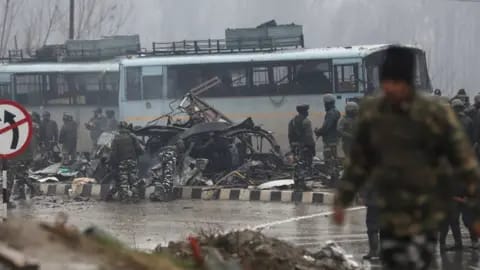
The antecedent to this provocation requires little elaboration for those that are conversant with the security landscape of the subcontinent. On 14th February, 2019, a suicide bomber affiliated with the Jaish-e-Mohammed terrorist group detonated an improvised explosive device (IED) of a rather catastrophic magnitude against a convoy of the Central Reserve Police Force (CRPF) traversing the valley of the Pulwama district of Jammu and Kashmir. Forty Indian paramilitary personnel perished in the fiery conflagration with their lives extinguished in an instant of barbaric violence that sent tremors of grief and indignation throughout the nation. This atrocity, arguably the deadliest such assault upon Indian security forces in three decades represented the latest iteration of Pakistan’s pernicious strategy of a thousand cuts, wherein Islamabad’s deep state apparatus, principally the Inter-Services Intelligence (ISI) directorate prosecutes its territorial ambitions through deniable militant proxies rather than conventional military engagement. Yet, what transpired in the immediate aftermath of Pulwama distinguished itself markedly from previous cycles of provocation and response. Where earlier governments might have confined themselves to diplomatic protestation and international appeals, the new administration in New Delhi elected instead to demonstrate that India’s strategic patience, whilst considerable, was definitely not infinite. The strike upon Balakot targeting a terrorist training encampment nestled within Pakistani territory proper rather than the disputed territories of Kashmir constituted an unprecedented escalation – a clear articulation that India would henceforth exercise its prerogative to conduct counterterrorism operations wherever necessary, irrespective of international boundaries that shielded perpetrators from justice, without fear from the nuclear wall that Pakistan shielded itself with.


The operation itself bore the hallmarks of meticulous planning and exceptional restraint operating in concert. 12 Mirage-2000 fighter jets penetrated Pakistani airspace under the cover of darkness, delivering precision-guided munitions upon structures that were identified with reputable intelligence, as training facilities for militants destined to perpetrate violence within Indian territory.
On a more crucial note, the strikes targeted terrorist infrastructure, rather than Pakistani military installations, thereby calibrating the response to punish terrorism whilst scrupulously avoiding actions in a rather marked manner that might precipitate uncontrolled escalation between the two nuclear-armed states. This delicate equipoise between decisive action and strategic prudence exemplified what might aptly be termed ‘India’s doctrine of decisive restraint,’ i.e. the capacity to project force with overwhelming effect whilst maintaining rigorous control over escalatory dynamics.
The contrast with Pakistan’s operational methodology could scarcely be more pronounced. Where Islamabad has systematically cultivated terrorist organisations as instruments of state policy – providing them sanctuary, training, and material support in flagrant violation of international law, India’s response adhered strictly to counterterrorism objectives. Where Pakistan seeks to destabilise its neighbour through clandestine violence perpetrated against civilian and paramilitary targets, India has always confined its retaliation to military-grade precision strikes against infrastructure directly implicated in terrorist operations or the facilitation thereof. This asymmetry in operational ethics underscores a fundamental distinction. India acts as a responsible regional power compelled to defend its citizens, whereas Pakistan persists in wielding terrorism as a tool of strategic coercion.
The Balakot operation yielded dividends that extended far beyond the immediate tactical objectives. Domestically, it galvanised national sentiment, demonstrating to an increasingly impatient populace that their government possessed both the capability and the resolve to exact consequences for terrorist aggression. Internationally, it compelled renewed scrutiny of Pakistan’s sponsorship of cross-border terrorism, particularly following Islamabad’s risible denials of casualties despite overwhelming evidence to the contrary. Most significantly perhaps, it established a new deterrent equilibrium. Henceforth, militant organisations and their state sponsors could harbour no illusions that Indian territory might be attacked with impunity.
In the final analysis, Balakot represented not an abandonment of restraint but rather its most sophisticated expression. Through measured force employed with clinical precision, India articulated a doctrine that balances the imperative of citizen protection against the exigencies of regional stability. This calibrated counterstrike stands as a testament to military prowess wedded to strategic acumen, a demonstration that resolve and responsibility need not exist in contradiction but may indeed constitute complementary virtues in the defence of the realm.