


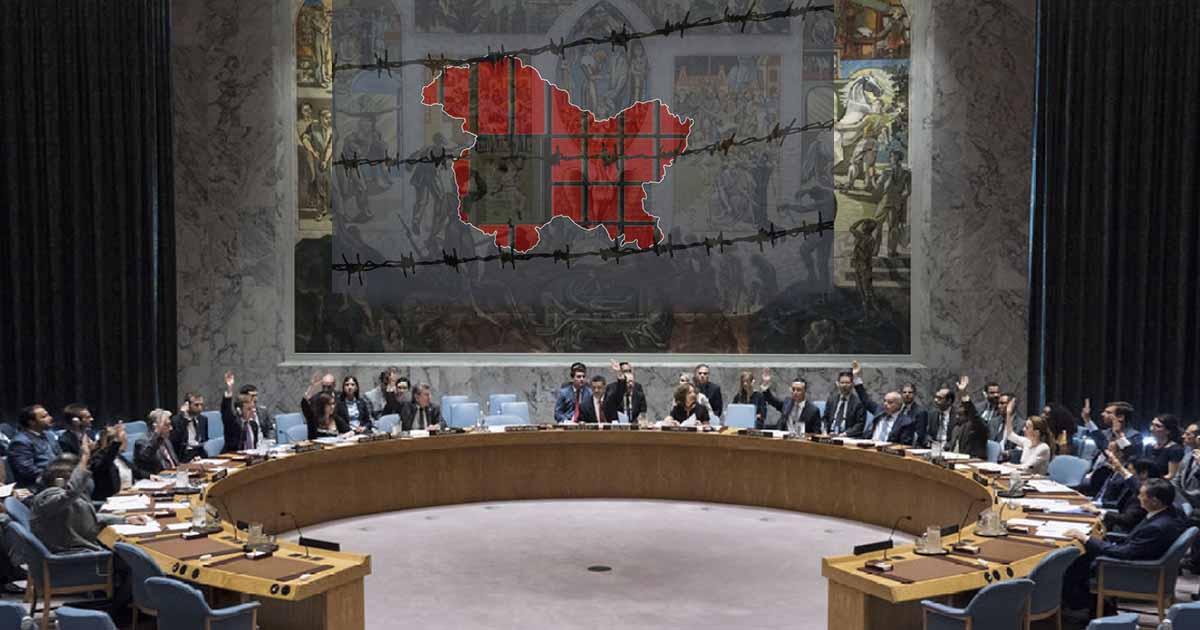
When the United Nations stepped into the Jammu and Kashmir conflict in 1948, it did so with a clear sequence in mind: stop the fighting, reverse the effects of armed infiltration, and only then explore political options. That process never moved beyond its opening stage. The reason lies not in paperwork or diplomacy, but in persistent non-compliance with the framework’s most basic requirement.
For people in Jammu and Kashmir, the stalling of the UN process is often described as a failure of international will. The historical record tells a different story.
A Framework Built on One Essential Condition
UN resolutions on Kashmir, beginning in 1948, placed withdrawal of armed intruders and irregular forces at the very start of the peace process. This step was considered essential to restore law and order and create conditions in which civilians could live without fear.
Only after such withdrawal was completed did the UN envisage further steps, including reduction of Indian forces and, eventually, any political consultation. The sequence was deliberate. Peace on the ground was treated as a prerequisite for politics, not the other way around.
Where the Process Broke Down
The UN process stalled because this first step was never carried out. Armed elements that had entered Jammu and Kashmir with support from across the border were not fully withdrawn. Infiltration continued, and the security situation remained fragile.
Under these conditions, reducing Indian forces was neither practical nor responsible. The Indian Army’s presence in the region was tied to its duty to protect civilians, secure communication lines, and prevent renewed violence. Expecting force reductions without a corresponding end to infiltration would have placed local populations at risk.
This unresolved disagreement over sequencing brought the UN framework to a halt.
The Limits of the United Nations
The United Nations Commission tasked with overseeing the process could observe, report, and mediate. It could not enforce compliance. It had no authority to compel withdrawals or penalise violations.
As a result, the UN found itself supervising a ceasefire without the means to complete the demilitarisation it had identified as necessary. The process did not collapse suddenly; it gradually ran out of political space as disagreements hardened and trust eroded.
How the Narrative Shifted
Over time, attention moved away from the conditions attached to the UN framework and focused almost entirely on its final, unfulfilled stage. The requirement of withdrawal was quietly dropped from public discussion, while later political references were repeated without context.
This selective reading allowed Islamabad to project the image of an incomplete international promise, while avoiding discussion of the steps it was expected to take at the outset. The result was a narrative that blamed delay on diplomacy, rather than on actions on the ground.
The Impact on Jammu and Kashmir
For Jammu and Kashmir, the stalling of the UN process meant a prolonged security environment rather than an early political transition. The ceasefire held, but it did not deliver peace in the fuller sense. The Indian Army continued to play a stabilising role, ensuring that violence did not return to the scale seen in 1947–48.
The failure of the UN framework thus had direct consequences for daily life in the region. It shifted responsibility for stability away from international mechanisms and onto domestic institutions.
Why This History Matters
Understanding why the UN process stalled is important because it corrects a long-standing misconception. The framework did not fail due to indecision or neglect. It failed because its foundational condition was never met.
For Jammu and Kashmir, this history explains why international mediation gradually gave way to bilateral arrangements and internal security management. It also explains why calls to “revive” old UN resolutions ignore the circumstances that prevented their completion in the first place. The lesson is simple: processes built on conditions cannot move forward when those conditions are ignored.
(Hailing from Kashmir and based in New Delhi, Mehak Farooq is a journalist specialising in defence and strategic affairs. Her work spans security, geopolitics, veterans’ welfare, foreign policy, and the evolving challenges of national and regional stability.)