

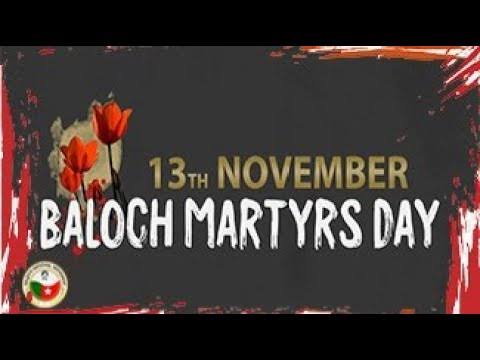
November 13, observed as Baloch Martyrs Day, is a day of solemn remembrance and defiance for Baloch communities worldwide. On this day, the Baloch honor the countless lives lost fighting against Pakistan’s oppressive policies and violent suppression in Balochistan. The Baloch resistance movement, embodied by groups like the Baloch Liberation Army (BLA), has consistently opposed Pakistan’s military and the Inter-Services Intelligence (ISI), which is widely, accused of brutal human rights abuses, including enforced disappearances, extrajudicial killings, and systematic torture. Despite decades of violent repression, the Baloch people’s fight for justice and self-determination stands unshaken, even as Pakistani forces escalate their tactics against civilians.
Historical Roots of Baloch Martyrs Day


The roots of Balochistan’s struggle trace back to 1948, just a year after Pakistan’s creation, when the region was forcibly annexed. Many Baloch viewed this act as an assault on their sovereignty, with no consent from the people of Balochistan. This early betrayal set the stage for decades of tension, as Pakistan, particularly the ISI and military, launched repeated operations to quash Baloch nationalist aspirations. The Baloch people, with a unique culture, language, and history, have consistently called for autonomy and control over their own resources, yet Pakistan has responded with heavy-handed tactics aimed at suppression rather than dialogue.
Pakistan’s military and the ISI have waged a ruthless campaign against Baloch communities. Human rights organizations, including Amnesty International and Human Rights Watch, have extensively documented allegations against the ISI for its role in enforced disappearances, secret detention facilities, and torture. Thousands of Baloch civilians, activists, journalists, and students have been reportedly abducted by the ISI. Families are left in anguish, with no knowledge of the whereabouts of their loved ones. Many of those who do return bear signs of torture, while others return only as lifeless bodies, with signs of brutal interrogation and torture often visible.
The ISI’s modus operandi appears to be an attempt to stifle any form of dissent in Balochistan. By intimidating, detaining, and disappearing Baloch voices, the ISI has effectively established a culture of fear, especially targeting individuals and groups that speak out against Pakistan’s exploitation of Balochistan’s natural resources.
The Baloch Liberation Army (BLA) and Organized Resistance
The Baloch Liberation Army (BLA) is among the most notable groups resisting Pakistan’s policies in Balochistan. Formed as a response to years of systemic exploitation and suppression, the BLA fights for Balochistan’s freedom from what it sees as colonial rule by Pakistan. Over the years, the BLA has expanded its operations against the Pakistani military, targeting critical infrastructure and military facilities as a way to make a statement against the exploitation and human rights abuses perpetuated by Islamabad and the ISI.
Statistical Evidence of BLA Attacks (2000-2024)
The following table provides an overview of BLA’s resistance activities, which have strategically focused on both economic and military targets:
Year
BLA Attacks
Pakistani Military Casualties
Civilian Casualties
Targets
2000-2010
~220
~600
~200
Gas pipelines, convoys
2015
68
160
30
CPEC infrastructure, Gwadar
2018
75
180
25
Military units, Quetta
2021
90
220
45
Karachi Stock Exchange attack
2023
85
210
50
Gwadar port, Army cantonments
2024
95
230
60
Oil installations, CPEC convoys
This data shows the BLA’s sustained resistance against the Pakistan military’s pervasive control over Balochistan, challenging their heavy-handed occupation.
The ISI’s War on Baloch Identity
The ISI has systematically attempted to erase Baloch identity by enforcing arbitrary restrictions on cultural expression, limiting access to media, and intimidating journalists who report on Baloch issues. This censorship is paired with propaganda portraying the Baloch as separatists and criminals, attempting to delegitimize their struggle in the eyes of the rest of Pakistan and the world. Reports indicate that the ISI continues to intimidate and silence journalists and activists both within Pakistan and internationally, often through coercive and violent methods.
Baloch students studying in other parts of Pakistan are reportedly harassed and discriminated against, facing constant surveillance and restrictions, depriving them of an equal opportunity to learn and express their identity. Many young Baloch have taken to the resistance, seeing no alternative to living under ISI surveillance, economic marginalization, and the threat of being disappeared.
Balochistan’s Exploitation under the China-Pakistan Economic Corridor (CPEC)
The China-Pakistan Economic Corridor (CPEC) has exacerbated tensions, with Baloch resources exploited under agreements that the local population deems unfair. The BLA has frequently targeted CPEC infrastructure, viewing it as an extension of Pakistani exploitation in which Balochistan’s natural resources are diverted to benefit other regions and foreign investors, while the Baloch remain impoverished and underserved. By intensifying attacks on CPEC-related projects, the BLA sends a clear message that these resources belong to the Baloch people and should be used for their development, not to fuel further military occupation.
Human Rights Concerns and International Condemnation
The international community has repeatedly condemned Pakistan’s treatment of the Baloch. Reports of enforced disappearances, killings, and torture by the ISI have prompted calls for investigations by human rights bodies. The United Nations and various global organizations have criticized Pakistan’s disregard for basic human rights in Balochistan, yet the ISI continues to operate with impunity, intensifying efforts to crush any form of resistance and silence the voices demanding autonomy. Baloch Martyrs Day serves as a reminder of the ISI’s merciless tactics and the Pakistan military’s brutal occupation of Balochistan. While the state continues to paint Balochistan’s struggle as insurgency and terrorism, the facts on the ground reveal a people determined to resist the systematic exploitation of their land and the erasure of their identity. As the Baloch people honor their martyrs on November 13, they send a message of resilience and demand justice. The ongoing Baloch resistance against the ISI and Pakistani military underscores the urgent need for international intervention to hold Pakistan accountable. The Baloch people’s struggle for self-determination remains unyielding, demonstrating that they will not bow to intimidation, resource exploitation, or cultural suppression. Instead, they continue to honor their martyrs and demand a future free from Pakistan’s occupation and ISI’s iron grip.