

Aazan Manzoor


Srinagar, Nov 27 (JKNS): Days after videos showing a JCB excavator operating near the ecologically sensitive Sheshnag Lake along the Amarnath Yatra route went viral on social media, triggering widespread environmental concerns and a political controversy, the Jammu and Kashmir Government has released a detailed clarification along with Google satellite imagery, maintaining that no new road construction or fresh alignment is being undertaken near the lake.
The report comes amid growing concerns among environmentalists, experts and nature lovers over possible ecological damage and alleged environmental violations in Jammu and Kashmir’s fragile Himalayan ecosystem. Experts have repeatedly cautioned that any unregulated construction, excavation or disturbance in ecologically sensitive areas such as the Sheshnag region could have far-reaching consequences for its delicate environment, natural drainage systems, water bodies and biodiversity. The controversy has once again brought into focus the need for strict environmental safeguards, scientific assessment and accountability before undertaking any activity in such sensitive mountain landscapes.
The clarification comes after Chief Minister Omar Abdullah took cognisance of the viral footage and directed Forest Minister Altaf Ahmad Kaloo to submit a detailed report and ascertain whether any violation or deviation had taken place during the ongoing work near the high-altitude lake.
In its report, accessed by news agency JKNS, the Forest Department, J&K, stated that the track originating from Chandanwari, passing through Sheshnag and leading towards the Holy Cave, undergoes annual maintenance to ensure its safety and accessibility for pilgrims. It maintained that the exercise is longstanding and has been undertaken regularly since 2012, and is not a new activity initiated in 2026.
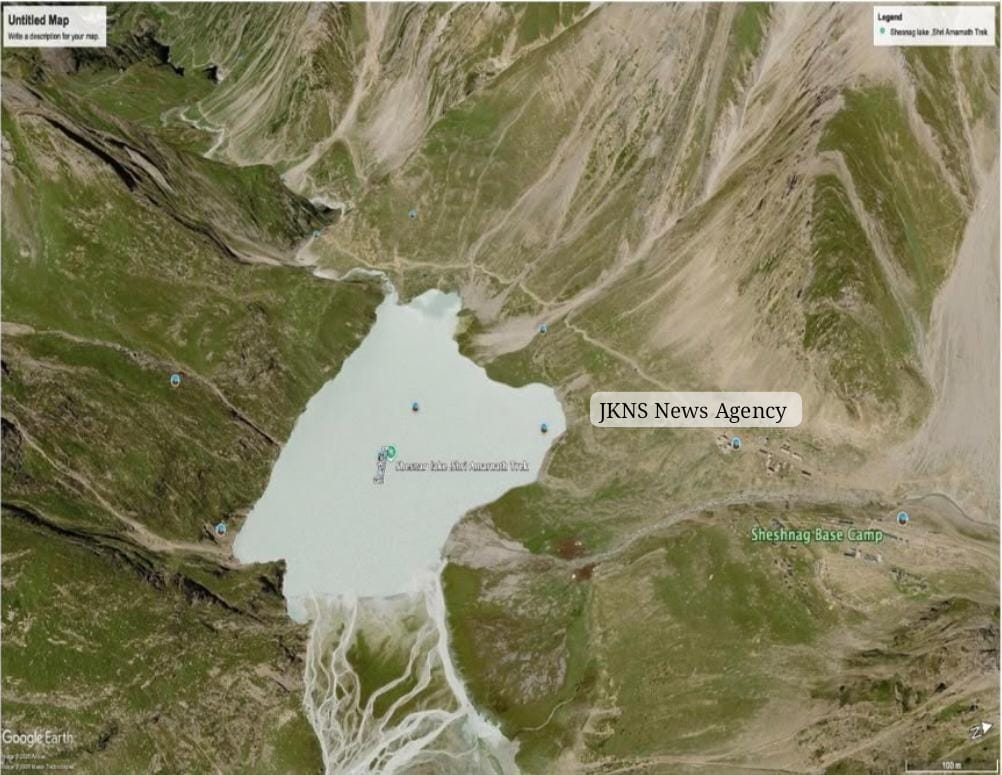
The government has also released Google satellite imagery depicting the existing track and its alignment from Chandanwari to the Holy Cave. According to the official clarification, the imagery shows that the track runs parallel to Sheshnag Lake while maintaining a distinct separation from its shoreline.
The department further clarified that the Yatra track runs along the right-hand side of the lake and is situated at a considerable distance from the water body, asserting that the maintenance activity is not intended to alter the lake’s character or ecological integrity.
Explaining the legal basis for the maintenance work, the department referred to the Supreme Court’s directions in PIL Court on its own motion versus Union of India and Others (Suo Motu Writ Petition Civil No. 284 of 2012).
The Supreme Court had emphasised that the Amarnath Yatra walking tracks should have a minimum width of 12 feet to facilitate the simultaneous movement of pilgrims, horses and palkis, besides directing improvements to vulnerable stretches, including protective measures such as retaining walls, railings and other necessary structural support.
However, the court had specifically clarified that its directions should not be interpreted as permitting the construction of a motorable metalled road in place of the existing walking tracks.
The Forest Department stated that, in accordance with these directions, the responsibility for maintenance of the Yatra track rests with the Border Roads Organisation (BRO), and the activity shown in the viral footage forms part of its routine annual maintenance operations.
It categorically maintained that no new road construction or fresh alignment is being undertaken.
How the controversy erupted
The controversy erupted after a video, originally circulated through social media by an excavator operator, showed a heavy crawler excavator operating near the blue waters of Sheshnag Lake. The footage, which subsequently went viral, triggered questions over the use of heavy machinery in the fragile Himalayan ecosystem and concerns about possible damage to the lake and its surrounding landscape.
Environmentalists, political leaders and other concerned citizens questioned the necessity of excavation in the vicinity of the high-altitude water body and sought clarification regarding the nature of the work, environmental safeguards and the permissions obtained.
The Border Roads Organisation subsequently defended its operations, stating that the work was part of post-Amarnath Yatra track maintenance and stabilisation, with a focus on widening vulnerable stretches, improving safety and easing congestion during the annual pilgrimage. BRO maintained that the work was confined to existing tracks and that measures were being taken for safe disposal of excavated material, protection of natural drainage and minimising disturbance to the surrounding terrain.
The issue subsequently reached the political corridors, with PDP president and former Chief Minister Mehbooba Mufti questioning the ongoing work and seeking clarity over the possible ecological impact. She also attempted to visit Sheshnag Lake along with party leaders but was stopped by police at Chandanwari, with security reasons cited for restricting her movement.
Environmental concerns were also raised by religious figures, political representatives and activists, who called for protection of the ecologically sensitive area.
Amid the growing controversy, Chief Minister Omar Abdullah directed the Forest Minister to examine the matter and ascertain whether any deviation from the existing alignment or violation had occurred.
Forest Minister Altaf Kaloo subsequently said that a departmental team had inspected the site and found no evidence of tampering or damage to the lake. He maintained that no soil or debris had entered the water body and that the work was being carried out by BRO as part of routine track maintenance.
The latest government clarification, accompanied by satellite imagery and references to the Supreme Court’s 2012 directions, seeks to place the ongoing work in the context of the longstanding maintenance requirements of the Amarnath Yatra route and the safety of pilgrims.
The government has maintained that the matter should be viewed in light of the judicial directions, pilgrimage safety requirements and the longstanding nature of the track maintenance exercise. (JKNS)