

Dealer commission increased from ₹108 to ₹195 per quintal; Department intensifies e-KYC drive, directs face authentication rollout from current month’s distribution cycle amid confusion over mandatory requirements


Aazan Manzoor
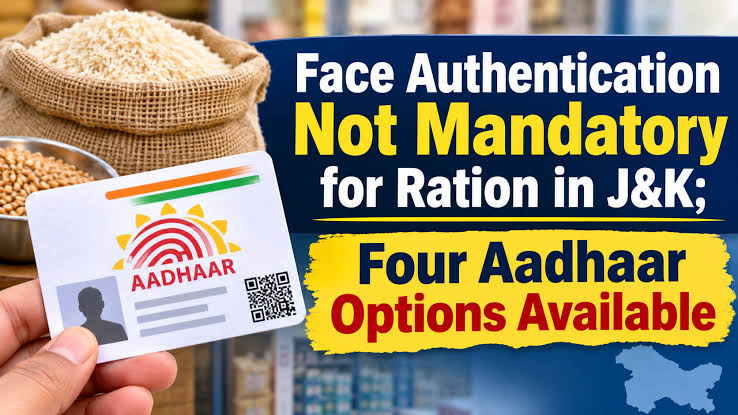
Srinagar, Nov 11 (JKNS): Amid confusion and concerns among ration card beneficiaries over the reported introduction of mandatory face authentication for drawing ration under the Public Distribution System (PDS) in Jammu and Kashmir, Commissioner Secretary, Food, Civil Supplies and Consumer Affairs (FCS&CA) Department, Sourabh Bhagat, clarified that face authentication is not compulsory and beneficiaries can avail of their entitled ration through any of the four available Aadhaar authentication methods.
Speaking to news agency JKNS, Bhagat said the Aadhaar-based authentication system has been in operation since around 2020 and is aimed at ensuring transparency in ration distribution, preventing diversion and black marketing of foodgrains, and ensuring that the entitled ration reaches genuine beneficiaries.
Explaining the evolution of the authentication process, Bhagat said that initially only thumb-based biometric authentication was available, but the system has now been expanded to provide three additional options, taking the total number of authentication methods to four.
“Earlier, there was only one methodology, which was thumb authentication. Now we have introduced three more technologies. One is iris scan, which is unique and can identify a beneficiary. The second is OTP authentication, under which an OTP is received on the beneficiary’s mobile phone and can be shared with the dealer for receiving ration. The third is face authentication,” he said.
Clarifying the most important concern surrounding the reported mandatory face authentication, Bhagat said that none of the four methods is compulsory individually and beneficiaries are free to choose any one of the available authentication options.
He said the expansion of authentication methods has been introduced to provide greater convenience to beneficiaries and ensure that no one faces unnecessary difficulty in collecting ration.
**Any adult family member can collect ration**
Addressing another widespread misconception that only the head of the ration card-holding family can authenticate and collect ration, Bhagat categorically clarified that any adult member of the family can visit the Fair Price Shop and receive the entitled ration.
He said that if the head of the family, including the father, is unable to visit the ration depot because of work or other commitments, another adult member, including the mother, son, daughter, brother or sister, can collect the ration on behalf of the family.
“People have a misconception that only the head of the family can do it. No, any member can do it. Suppose your father cannot go to the ration shop, your mother can go. If she cannot go, you can go, or your brother or sister. Any adult member of the family can go and collect the ration,” Bhagat said.
He, however, clarified that a minor child should not be sent independently to collect ration, stressing that an adult family member should undertake the process to ensure that the child is not misled or exploited.
He said the wife or any other adult member of the household can visit the ration depot and complete the authentication process.
**Face authentication, OTP provide alternatives in special circumstances**
Explaining the arrangements for beneficiaries who may face physical difficulties in completing thumb-based biometric authentication, Bhagat said the availability of multiple authentication options addresses such situations.
Giving an example, he said that if a beneficiary has lost or does not have a functional right hand, face authentication can be used as an alternative to thumb authentication.
“Suppose someone does not have a right hand, then he can go for face authentication. We have provisions for such circumstances,” he said.
He further explained that OTP authentication can also facilitate families who are unable to visit the ration shop personally.
Giving an example of a household comprising a mother and two daughters, Bhagat said that where the beneficiary is unable or unwilling to visit the Fair Price Shop, the OTP-based facility can be used to complete the authentication process through the mobile phone, with the assistance of the dealer.
**WhatsApp messages creating confusion over mandatory face authentication**
Referring to the confusion circulating among people, Bhagat said messages claiming that face authentication had become compulsory were being widely circulated through WhatsApp groups, creating unnecessary apprehensions among ration card holders.
Bhagat also alleged that certain elements, particularly those opposing changes in the existing ration distribution mechanism, were spreading apprehensions and raising objections against the new system.
He said the technology-based mechanism introduced by the Government of India was designed to ensure accountability at every stage of ration distribution and prevent irregularities in the system.
“At one time, there were instances of dealers indulging in irregularities and misappropriation of ration. Now the Government of India has established a very good system to ensure that every grain reaches the rightful beneficiary. You cannot divert ration without authentication,” he said.
Explaining how the digital mechanism monitors the distribution of foodgrains, Bhagat said the computerised system maintains records of the quantity allocated and the number of beneficiaries who have actually collected their ration through Aadhaar authentication.
He said that if a dealer is supplied four quintals of ration for 500 beneficiaries but only 300 beneficiaries collect their ration through Aadhaar authentication, the system will reflect the remaining 200 beneficiaries.
“Suppose we give four quintals of ration to a dealer for 500 people, but only 300 people take ration using Aadhaar, then the computer will show that 200 beneficiaries have not collected their ration. The system scrutinises everything. This is how the mechanism ensures accountability,” he said.
Bhagat alleged that some union leaders were uncomfortable with the new mechanism because it had restricted the scope for misappropriation and diversion of foodgrains.
He further alleged that certain people were raising objections by citing issues such as non-availability of internet connectivity, failure of thumb authentication or other technical difficulties, while seeking suspension of the system for a month or two.
According to him, the objective of such demands was to create a situation in which the existing accountability mechanism could be temporarily discontinued, allowing irregularities in ration distribution to continue.
**J&K among regions introducing advanced face authentication technology**
Bhagat said the authentication mechanism was part of the broader Sarthak PDS initiative and that the Government of India had introduced the system across the country to strengthen the Public Distribution System.
He said the technology was being implemented across different states, from Assam to Gujarat, and Jammu and Kashmir had adopted an advanced version of the authentication mechanism by introducing face authentication.
Describing face authentication as a more convenient and efficient option, he said the process generally takes around 40 to 50 seconds at a Fair Price Shop.
Explaining the procedure, he said the dealer enters the beneficiary’s details into the system, following which a red circle appears on the screen. The beneficiary has to position their face within the designated circle and blink, after which the system completes authentication.
He said the process takes less time than thumb-based biometric authentication and OTP verification.
“Face authentication is a very solid technology. You can visit your ration shop and see for yourself. It will take a maximum of 40 to 50 seconds. The dealer enters your details, a red circle appears on the screen, and as soon as you blink your face within it, authentication is completed,” Bhagat said.
**Sarthak PDS launched nationwide from April 1; dealer commission increased**
Bhagat also disclosed that the initiative is part of the Sarthak PDS project, which was initiated by Prime Minister Narendra Modi from April 1 across the country.
In an important announcement concerning Fair Price Shop dealers, Bhagat said the Government of India has also increased the dealer margin payable for ration distribution in Jammu and Kashmir, the Northeastern states and other hilly states.
He said the dealer margin, which was earlier Rs 108 per quintal, has now been increased to Rs 195 per quintal.
“Earlier, the dealer margin was Rs 108 per quintal. Now the Government of India has increased it to Rs 195 per quintal for Jammu and Kashmir, the Northeastern states and hilly states. This is almost double the earlier amount,” he said.
Explaining the financial benefit of the revision, Bhagat said a dealer who was previously earning around Rs 10,000 would now be able to earn approximately Rs 20,000, depending on the quantity of ration distributed.
He said the increase in dealer margins was also intended to ensure that dealers did not face financial difficulties while the government tightened the monitoring and authentication mechanism.
“There is nothing for the dealers to worry about. Their earnings are increasing, while the system is becoming more transparent. The objective is to ensure that nobody can steal or misappropriate ration,” he said.
Bhagat said there should be no objection to a transparent system that protects the interests of genuine beneficiaries and ensures that foodgrains reach those entitled to receive them.
He further remarked that irregular practices in ration distribution were being brought to an end through the strengthened mechanism.
**Department intensifies e-KYC, face authentication rollout amid concerns**
The clarification comes amid the FCS&CA Department’s ongoing push for Aadhaar-based e-KYC and face authentication in ration distribution across Jammu and Kashmir.
During a review meeting held on November 5, Commissioner Secretary Sourabh Bhagat had directed officials to intensify efforts to complete the e-KYC of pending beneficiaries and introduce the Face Authentication Application from the current month’s ration distribution cycle.
The Commissioner Secretary had chaired an online review meeting to assess the functioning and progress of various departmental initiatives being implemented across Jammu and Kashmir.
The meeting was attended by Director General, FCS&CA, Jammu, Rajesh Kumar Shavan; General Manager, Food Corporation of India (FCI); Director IT, Sanjay Gupta; Deputy Commissioners and Assistant Directors from different districts through video conferencing.
Director General FCS&CA Jammu, along with Assistant Directors of the respective districts, presented a point-wise assessment of the latest status of departmental activities.
The review covered lifting and distribution of foodgrains, winter stocking arrangements for six-month and three-month requirements, Aadhaar-based e-KYC, face authentication, Central Bank Digital Currency (CBDC) implementation and other priority issues.
During the deliberations, Bhagat directed the concerned officers to ensure expeditious lifting and distribution of foodgrains well before the onset of adverse weather conditions, particularly in view of the approaching winter and the possibility of disruption due to inclement weather.
He stressed that both six-month and three-month winter stocking arrangements must be completed within the prescribed timelines and directed FCI authorities to ensure the supply of quality foodgrains to the department.
**Remote areas to be identified for departmental petrol outlets**
Reviewing the availability and status of petroleum products, the Commissioner Secretary directed the respective district administrations to identify remote and far-flung areas where petrol pump facilities are presently unavailable.
He asked the concerned authorities to work out suitable modalities, in consultation with Oil Marketing Companies (OMCs), for establishing departmental-owned petrol outlets to facilitate the general public, particularly during emergencies and other exigencies.
**CBDC rollout scheduled in phases across J&K**
The Commissioner Secretary also reviewed the implementation of the Central Bank Digital Currency (CBDC) project under the Public Distribution System and emphasised the need for coordinated efforts by all stakeholders to ensure its timely rollout as per the timelines prescribed by the Government of India.
During the meeting, it was informed that the project is scheduled for pilot implementation in Jammu and Srinagar districts with effect from November 15, 2026.
The next phase will cover Samba, Kathua and Udhampur districts by November 30, 2026, followed by its implementation across the entire Union Territory by December 31, 2026.
Bhagat directed the district administrations and Assistant Directors to complete the requisite groundwork, beneficiary data preparation and other implementation-related modalities well in advance.
He also asked NIC and PNB authorities to expedite beneficiary data validation and whitelisting, besides creating login IDs for Fair Price Shop dealers, to ensure that the project is rolled out within the prescribed timelines.
**Special e-KYC camps, 95 per cent coverage target**
Reviewing the progress of Aadhaar-based e-KYC of National Food Security Act (NFSA) beneficiaries, Bhagat directed district administrations to intensify efforts to complete the verification of all left-out beneficiaries.
He stressed the implementation of the Face Authentication Application from the current month’s ration distribution cycle to strengthen transparency and ensure seamless authentication at Fair Price Shops.
The Commissioner Secretary also directed the concerned officers to organise special e-KYC camps across districts and ensure complete saturation of beneficiary verification.
He said districts achieving 95 per cent or above e-KYC coverage would be suitably appreciated.
He added that consolidated progress in beneficiary verification would also help the department take up the matter with the Government of India for additional funding and support for innovations under the Sarthak PDS project.
Bhagat further stressed the need for genuine and rightful verification of beneficiaries to ensure that the benefits of the Public Distribution System reach only eligible beneficiaries.
The status of e-KYC of migrant ration card holders was also reviewed during the meeting, with directions to expedite all pending cases.
**Five Fair Price Shops in each district to be modernised**
As part of efforts to modernise the Public Distribution System, the Commissioner Secretary directed all district administrations to identify five Fair Price Shops in each district for modernisation under a convergence plan involving the Mahatma Gandhi National Rural Employment Guarantee Act (MGNREGA) and other applicable schemes.
**Additional granaries, government godowns planned in remote areas**
Bhagat also directed district administrations to identify suitable land for the establishment of additional granaries and government storage godowns, particularly in remote, far-flung and border areas.
He said strengthening storage infrastructure in such areas would help ensure uninterrupted availability of essential commodities during emergencies and other exigencies, particularly when adverse weather conditions disrupt transportation and supply chains. (JKNS)