

Srinagar, Oct 8 (JKNS): A group of students at Islamia College of Science and Commerce, Srinagar, came together for a creative conversation on Kashmir’s rich cultural and craft heritage, exploring the significance of Srinagar’s recognition as a World Craft City and the need to connect the younger generation with traditional arts and crafts.

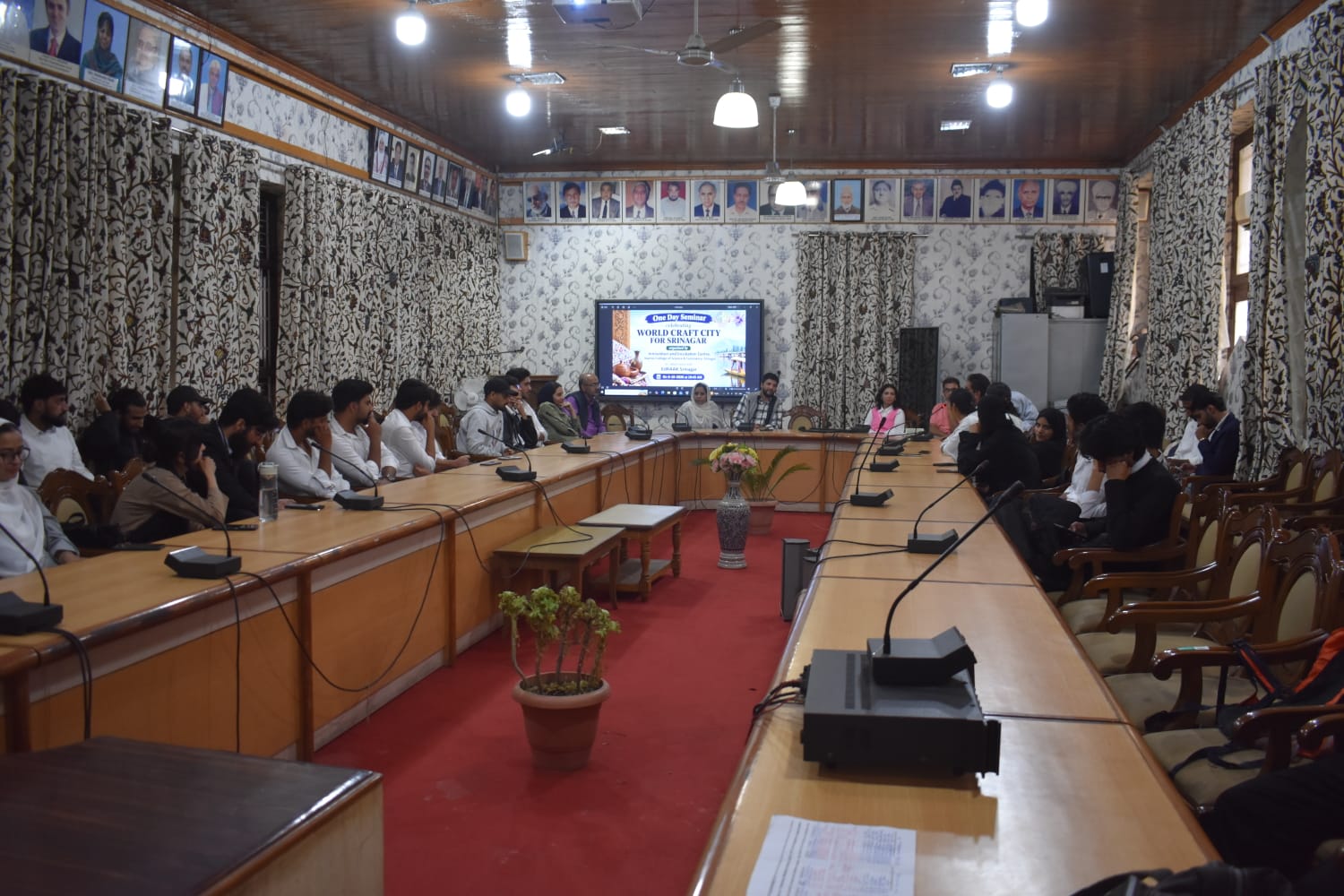
The college auditorium wore a unique look this week as it hosted a conversation on World Craft City with the young generation. The students discussed traditional and beautifully crafted handmade crafts that have contributed to Srinagar receiving the title of World Craft City.
The occasion also provided an opportunity to interact with the contemporary generation and discuss the opportunities and challenges related to the craft heritage of Kashmir, particularly that of the old city where the institution is located.
The seminar was organised by the Design and Innovation Cell, Islamia College of Science and Commerce, Srinagar, in collaboration with EdRAAK, Srinagar—an entrepreneurial initiative working in the field of art, crafts and heritage in Kashmir.
Against the backdrop of celebrations marking the World Crafts Council’s recognition of Srinagar as a Craft City, and coinciding with the upcoming World Heritage Week, the conversation explored different dimensions of Kashmir’s rich culture through a deeper understanding of its crafts.
Through the series of ‘creative conversations’ on crafts, cuisine, fashion and oral literature, young participants discussed different aspects of their historical legacy, shared their own experiences and connected emotionally with the traditions of Kashmir.
The initiative also envisions bringing together Gen Z to understand and discuss the “Essence of being Kashur”. The group also walked through the lanes of the old city and explored special displays of craft and cuisine.
The special conversation was inaugurated by the college Principal, Mr Aijaz Ahmad Hakak. He spoke about how the college has been encouraging young minds to take the lead in arts, crafts and heritage.
“Seminars like EdRAAK Naqsh-o-Nigar help aware young students about the significance of the World Craft City, Srinagar,” he said.
He thanked EdRAAK for conducting a series of activities to sensitise students about the arts and crafts of Kashmir.
Dr Zahoor Ahmad Jhat, Head of Department and Head, DIC, Islamia College, hosted the seminar and spoke about the importance of such international accreditation.
He said, “Innovation and Design Cell has been guiding young students who come with creative ideas in different subjects. The collaboration with EdRAAK is one such example where we engage in conversations about art and heritage.”
S. Iliyas Rizvi, Craft and Heritage Consultant, student of Papier-Mâché at DIC, Central University, and founder of EdRAAK, presented his conversation titled “Srinagar: The Craft City”.
He said, “Such unique sessions encourage Gen Z to know about the cultural aspect of society. As Srinagar has become the World Craft City, on its anniversary celebrations we must work together further with young minds who have extraordinary acumen and need mentorship to have in-depth knowledge of our rich crafts.”
“The present education system should focus beyond the syllabus that not only overburdens the students and at times makes knowledge boring. The signs and symbols of Kashmir in day-to-day life, like using ‘Nadma’—woollen-made textile furnishing in Kashmir—is fast vanishing. To preserve such unique crafts that are our symbols needs world attention, as these are less explored. The WCC recognition is a huge opportunity to position Kashmir on the Craft Map of the World,” he said.
Iliyas said, “The conversation has been to reach out to the coming generation who want to know about our place, people, lifestyle and cuisine which is unique to our geography and history. Gen Z is more inquisitive about such knowledge and our approach to reaching out to them has to be contemporary, using tools that create expressions which relate to us.”
“The dedication and spirit of our young generation is what is being observed in these presentations. Every young speaker has a deep understanding of the traditions of art and craft and how these need to be channelised, keeping us alive through these recognised titles of World Craft City and UNESCO’s Creative Craft Network,” he said.
Jasirah Qadri, a NIFT graduate and visiting faculty at DIC, Central University, presented and spoke about branding Kashur crafts and encouraging younger generations to play an active role in marketing and making a name in traditional handmade skills.
She said, “I believe our role goes beyond preserving and celebrating the rich heritage that defines our community. We need to create avenues to understand our youth who already are curious about creating stories on our traditions and a sense of identity.”
“It is truly inspiring to see the young generation embracing this responsibility with such passion and dedication to have a conversation on our art and culture. EdRAAK is really an impressive initiative to encourage talks on creative resources that are otherwise much less talked about within the contemporary generation,” she said.
The internationally recognised master craftsman of Papier-Mâché, Ustaad Syed Sajjad Hamedani, who teaches the craft at DIC, Islamia College, interacted with the students about recognising their skills and how such platforms help generate conversations around unknown artists of Kashmir.
“We need to think beyond the conferences and seminars and engage new generations in such crafts by giving them mentorships and…” he said.
Nadiya Zehra, who works and documents with EdRAAK, said, “The platform to showcase and express about crafts of Kashmir is unique for our generation who wants to share their creative ideas with the world.”
She works with arts and heritage initiatives in Kashmir.
Mir Nabeeena, a college postgraduate and a Pashmina startup founder, shared her journey with crafts. It has been an emotional journey to reconnect with the family business of Pashmina.
Studying botany gave her knowledge of sustainability and how Pashmina goats of Ladakh are vulnerable to over-exploitation in the future. She shared her experience with her fellow students on how their multiple skills and studies in management, literature and other fields can contribute to the craft sector.
Reyan-ul-Rafiq, founder of Tczoung’e Tou’el and a student of DIC, Central University, said it was a motivational conversation on crafts.
“Our generation loves and wants to revive cultural spaces, including the crafts,” he said.
Tczoung’e Tou’el is an online initiative for craft revival by Reyan, who designs beautifully crafted crochet and hand-knitted products that are otherwise stereotypically considered female-centric. He is breaking gender-specific mindsets among Gen Z.
EdRAAK (Educational Revival through Arts and Aesthetics in Kashmir) has been conducting various creative interventions for over a decade. From heritage and photo walks to arts and crafts workshops with children and young minds, EdRAAK has multidisciplinary verticals and involves mostly Gen Z through varied approaches to creativity at multiple levels, including psychological growth.
The “Haft Siin… Naqsh-o-Nigar” is one of the platforms for craft exchanges in contemporary times, fusing the use of technology and traditions.
Muneeb, an MBA student who has been working on Kani Pashmina and participating in such interactions for a few years, spoke about how initiatives can play a significant role in reaching craftsmen and reconnecting them with the younger generation, helping recognise their high skills and work towards better living standards by providing craftsmen the best wages they deserve. (JKNS)