


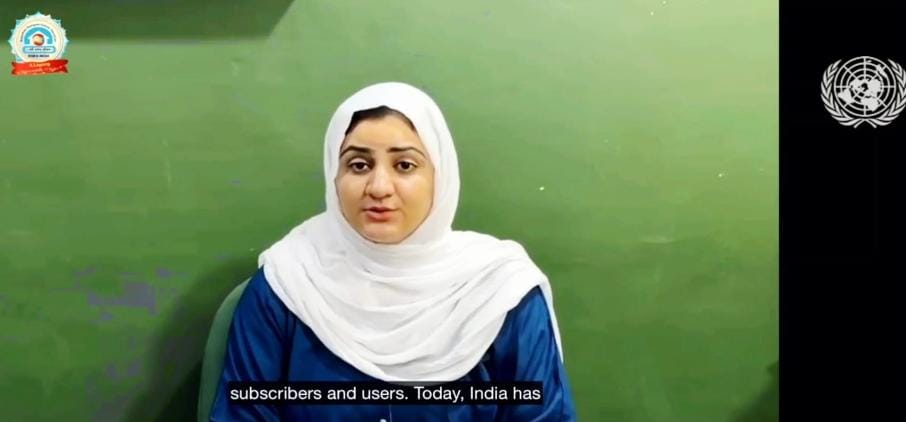
Srinagar, Sept 25 (JKNS): President of the Kashmir Women’s Organization, Darakshan Hassan Bhat, represented India at the 63rd Session of the United Nations Human Rights Council in Geneva, where she highlighted India’s expanding digital transformation and its impact on financial inclusion, public-service delivery and opportunities for women and rural communities.


As per news agency JKNS, Darakshan Bhat, President of the Kashmir Women’s Organization,
represented India at the 63rd Session of the United Nations Human Rights
Council in Geneva, where she highlighted the theme “Billions Connected,
Millions Empowered: India’s Digital Transformation.”
She highlighted India’s
expanding digital transformation and its role in advancing financial inclusion,
public-service delivery, and opportunities for women and rural communities.
Addressing
the Council, Bhat said India’s digital journey could be understood through
the extraordinary scale of its digital public infrastructure and the growing
reach of technology among ordinary citizens.
She noted that India had moved
from around 25.15 crore internet subscribers and users in 2014 to more than 109
crore internet users today, reflecting the rapid expansion of digital
connectivity across the country.
Highlighting
financial inclusion, Bhat said that more than 55 crore Jan Dhan accounts
have expanded access to formal banking, with women accounting for 55.7 per cent
of account holders.
She also pointed to the scale of Direct Benefit Transfer
(DBT), through which more than ₹53 lakh crore has been transferred directly to
beneficiaries, strengthening transparency and efficiency in welfare delivery.
India’s
digital payments ecosystem was another key focus of her address. Ms Bhat noted
that the country now processes more than 20 billion UPI transactions every
month, while over 5.6 lakh Common Service Centres are helping extend digital
and public services to rural and underserved communities.
She
placed particular emphasis on women’s participation in India’s digital and
financial transformation. According to the figures highlighted in her address,
more than 10 crore rural women are connected through Self-Help Groups, creating
a vast grassroots platform for financial inclusion, livelihoods and women-led
economic empowerment.
Ms
Bhat also highlighted the scale of India’s digital public infrastructure,
including more than 1.44 billion Aadhaar enrolments and over 724.3 million
DigiLocker users, while stressing the importance of privacy, consent,
cybersecurity and data protection as digital systems continue to expand.
“Digital
progress becomes meaningful when technology reaches those who have
traditionally remained furthest from opportunity,” Ms Bhat said.
She
emphasised that the true measure of digital transformation should not be
technology alone, but whether it expands access, opportunity and dignity for
people at the last mile.
In her concluding remarks, Ms Bhat called for greater
cooperation among governments, international institutions, civil society and
technology partners to build a digital future that is inclusive, secure, accessible and people-centred.
She
urged the international community to ensure that women, rural communities, and
vulnerable populations are not left behind as digital transformation
accelerates worldwide.
While presenting key facts and figures, she highlighted
that India’s internet users/subscribers have increased from 25.15 crore to more
than 109 crore; more than 55 crore Jan Dhan accounts have been opened, with
women accounting for 55.7% of account holders; over ₹53 lakh crore has been
transferred through Direct Benefit Transfer (DBT); more than 20 billion UPI
transactions are processed every month; over 5.6 lakh Common Service Centres
are providing digital services; more than 10 crore rural women are connected
through Self-Help Groups; Aadhaar enrolments have crossed 1.44 billion; and DigiLocker
has surpassed 724.3 million users.
The
figures presented at the Council underscored the scale at which India’s digital
public infrastructure is expanding access to connectivity, banking, digital
payments and public services.
The president Kashmir Women’s Organization
Darakshan also said that the larger objective should remain ensuring that the
benefits of digital transformation reach communities and individuals at the
last mile, particularly women, rural populations and vulnerable groups. (JKNS)