

Srinagar, Sept: 22 (JKNS): The National Institute of Technology (NIT) Srinagar on Tuesday inaugurated its Observatory for Astronomy and Astrophysics (NSOAA), opening a new facility for observational astronomy, astrophysics research, student training and public outreach on the campus.


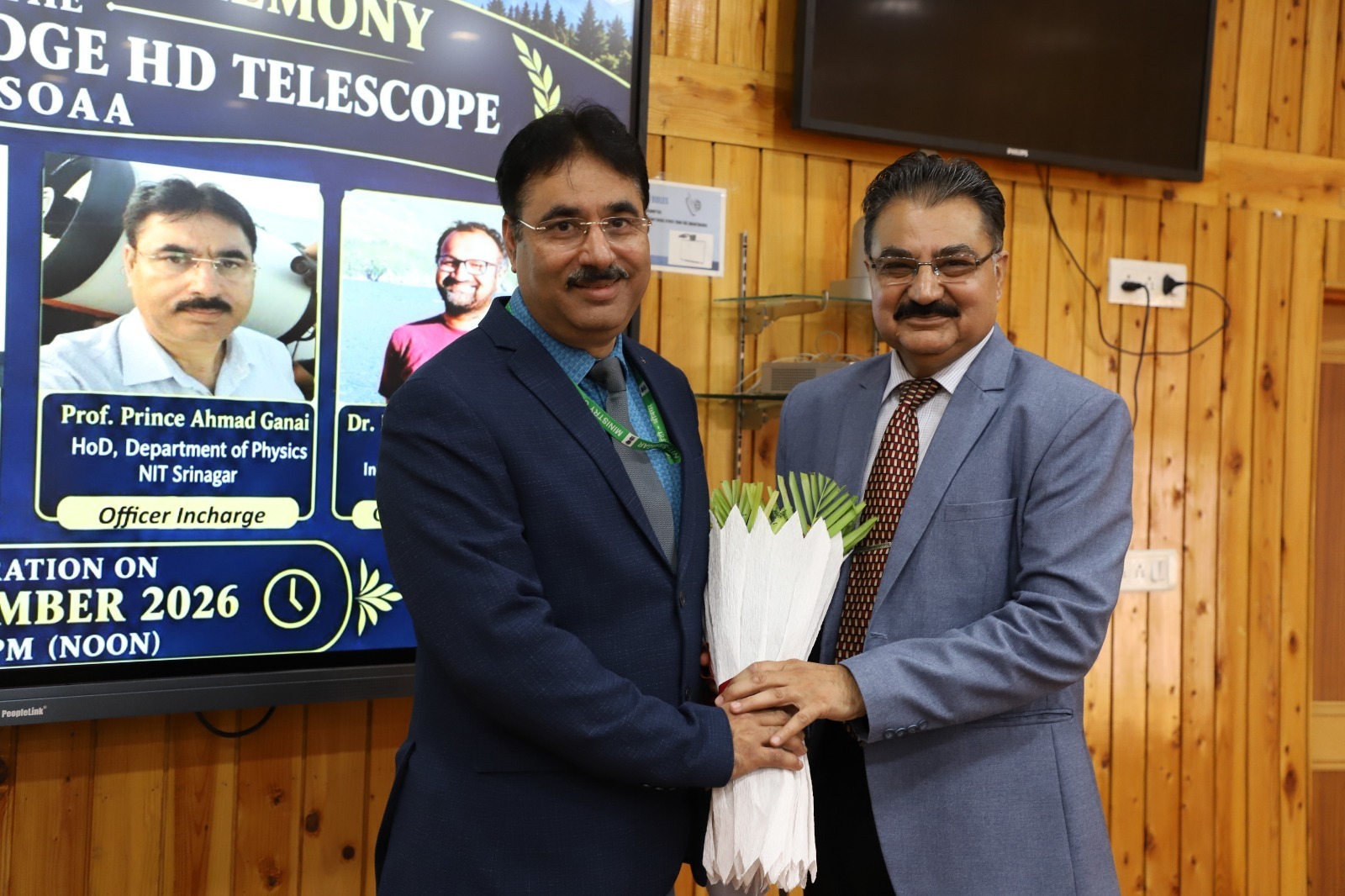
The observatory was inaugurated by Director NIT Srinagar Prof. Anurag Misra, Registrar, University of Kashmir Prof. Nasir Iqbal. The event was also attended by Dean R&C Prof. Roohi Naaz, Prof. GA Harmain, Head Physics, Prof. Prince Ahmad Ganai, senior faculty members, researchers and a large number of students.
The facility has been established around a 14-inch Celestron C14 EdgeHD aplanatic Schmidt-Cassegrain telescope, equipped with a computerised equatorial mount and advanced astronomical imaging systems.
The observatory includes planetary and cooled deep-sky cameras, LRGB filters, a 2.5× Barlow lens and high-speed imaging capabilities, enabling observations and imaging of the Moon, planets, nebulae, star clusters and distant galaxies. The telescope provides flat-field, aberration-free images and is designed to support both planetary observation and astrophotography.
Speaking on the occasion, Director NIT Srinagar Prof. Anurag Misra appreciated the efforts of the faculty behind the Imitative, and stated that the observatory would strengthen the Institute’s efforts to provide students with opportunities for experiential and interdisciplinary learning.
“An observatory of this nature creates a direct interface between classroom learning and scientific exploration. It will give our students an opportunity to observe, collect and analyse astronomical data while encouraging research, innovation and curiosity. We hope NSOAA will also strengthen NIT Srinagar’s engagement with schools, colleges and scientific institutions across Jammu and Kashmir,” Prof. Misra said.
KU’s Registrar Prof. Nasir Iqbal said the facility represented an important step towards strengthening scientific learning and collaboration in the region.
He said modern scientific infrastructure can play an important role in encouraging young students to explore emerging areas of science and research, adding that astronomy offers opportunities for collaboration across physics, engineering, computer science and other disciplines.
The observatory has been developed with scientific guidance and collaboration involving the Indian Institute of Astrophysics (IIA), Bengaluru. Dr Niruj Mohan Ramanujam of the IIA, who has expertise in astronomy education, science communication and public outreach, has been associated with the initiative as an advisor and collaborator.
The project also received technical inputs, discussions and guidance from young entrepreneur Murtaza Khan during the development of the facility.
Dr. Niruj Mohan Ramanujam (IIA), Bengaluru, joined the inauguration programme virtually. He is associated with NSOAA as an advisor and collaborator and brings expertise in astronomy education, science communication and public outreach.
Dr. Ramanujam said the establishment of the observatory could help make astronomy more accessible to students and the wider community.
“An observatory becomes truly meaningful when it is used as a space for learning, exploration and engagement. NSOAA can become an important platform for astronomy education and outreach in the region,” Dr. Ramanujam said.
The Observatory Committee includes Prof. G. A. Harmain of the Department of Mechanical Engineering, Prof. Shakeel Ahmad of the Department of Chemistry and Prof. Fayaz Ahmad Sofi of the Department of Civil Engineering, besides Dr. Niruj Mohan Ramanujam from IIA Bengaluru.
Prof. G. A. Harmain said establishing the observatory required coordination between scientific, engineering and technical expertise.
“The observatory is the result of collective vision, technical expertise, thoughtful discussions and teamwork. Facilities of this nature require contributions from people working across different disciplines, and it is encouraging to see those efforts come together in the form of a dedicated astronomical facility at NIT Srinagar,” Prof. Harmain said.
The initiative has been led and implemented by Prof. Prince Ahmad Ganai, Professor and Head, Department of Physics, NIT Srinagar.
Speaking on the occasion, Prof. Ganai said the observatory was conceived not merely as a telescope facility but as a platform for hands-on scientific learning, research, astrophotography and outreach.
“Our aim is to establish NIT Srinagar as a centre for astronomical learning, observation, research and outreach, connecting our students and the wider community with the universe through modern astronomical instrumentation, hands-on scientific exploration, interdisciplinary research and collaboration with leading institutions,” Prof. Ganai said.
Dr. Harkirat Singh, Assistant Professor in the Department of Physics, who presented the vote of thanks, said the observatory would complement the department’s academic and research activities.
He also thanked the institute leadership, faculty members, technical teams and collaborators whose contributions helped bring the facility to fruition. (JKNS)