


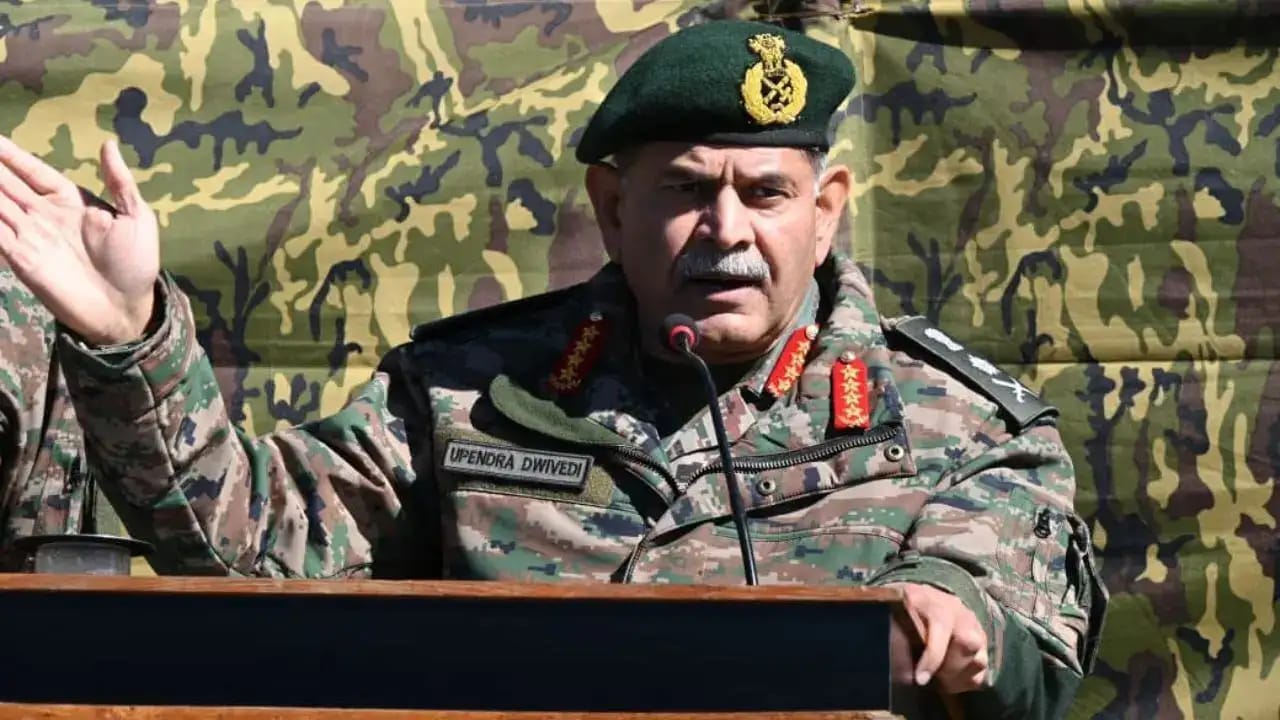
The story of how General Upendra Dwivedi became India’s “Drone General” does not begin with a drone. It begins with a decision — one that, in retrospect, shaped everything that followed.
Early in his tenure as Chief of Army Staff, General Dwivedi articulated a vision that was straightforward but demanding: every soldier in the Indian Army should become a technology-aware and drone-capable warrior. Not just specialist units. Not just officers. Every soldier. The ambition was radical for an institution historically built around mass, manpower and the enduring primacy of the infantryman.
To make that vision real required more than equipment. It required infrastructure. More than 25 Drone and Counter-Drone Hubs were established across military stations — facilities built to train, induct, operate and sustain drone systems at scale. The Army’s drone inventory, which stood at a few hundred when he took charge, crossed 50,000 by the time he prepared to retire on June 30, 2026. Precision engagement systems evolved to cover distances approaching 500 kilometres.
But the more consequential investments were structural. New formations were designed from the ground up for multi-domain warfare: Bhairav Battalions, Ashni Platoons, Rudra All Arms Brigades, Shaktibaan Regiments, Divyastra Batteries and the continuing development of Integrated Battle Groups. These were not the old army with new toys. They were new organisations, built around new assumptions about how battles would be fought and won.
The intellectual underpinning kept pace. Nearly 25 doctrines, strategic guidelines and policy documents were issued during his tenure, covering land warfare, space, red teaming and emerging domains. Eastern Ladakh became a live laboratory — a place where doctrine met terrain and technology met altitude, producing adaptations that no classroom exercise could replicate.
Operation Sindoor brought the threads together in the most demanding possible setting. Drones, loitering munitions, electronic warfare, real-time intelligence — all coordinated in a single operational campaign. For General Dwivedi, it was validation not just of capability but of concept. The Drone General had not built a drone army. He had built an integrated force in which drones were one lethal and versatile layer among many.
The self-reliance dimension added strategic depth. Indigenous drone and counter-drone development, pursued through DRDO, private industry, MSMEs and start-ups, meant that the capability being built was not contingent on foreign supply chains holding steady in a crisis. Nearly all special clothing requirements and a substantial share of ammunition are now sourced domestically. The Army General understood that a modern force dependent on external supply for its most critical systems is not truly modern at all.
None of this happened without resistance. Large institutions do not transform willingly. What General Dwivedi accomplished — and what may be his most lasting contribution — was changing the Army’s tolerance for change itself. He adapted feel like professionalism rather than disruption. He made the question “why aren’t we doing this differently?” feel more natural than “why should we change at all?”
The Drone General’s drones will be counted and catalogued by historians. But the shift in institutional culture he leaves behind may prove harder to measure — and more important to preserve.